How Modern DataOps Unlocks Reliable Insights for Growing Teams

September 17, 2026 · 2 reads
Introduction
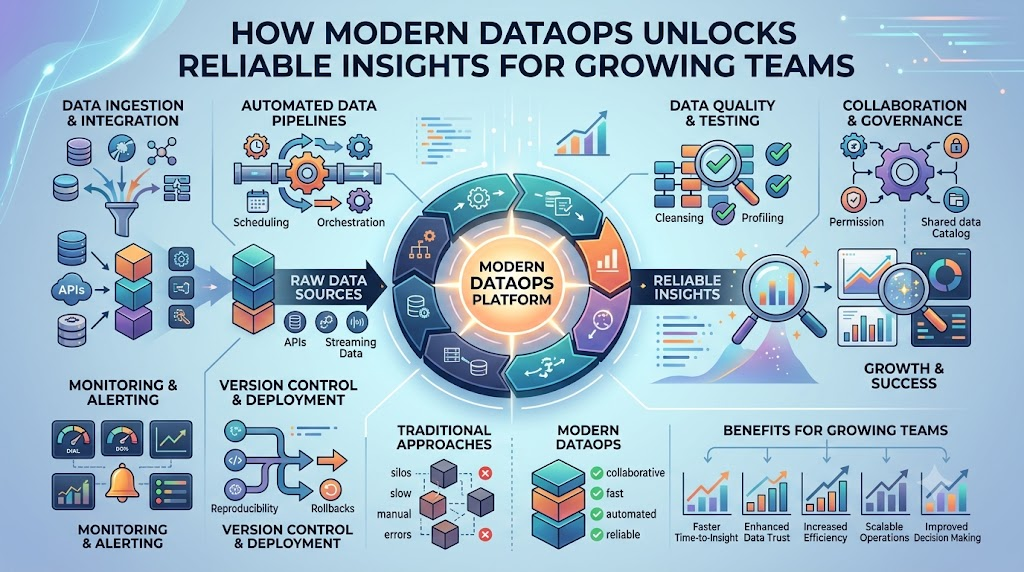
Picture a modern airport air traffic control tower. Hundreds of planes take off, fly across time zones, and land on tightly scheduled runways without bumping into each other. If radar screens freeze or runway lights flicker, the entire transportation network grinds to a sudden halt. Modern enterprise data pipelines operate like those busy runways. Every second, raw numbers, transactions, and user logs fly into company servers from dozens of sources. When data arrives late or contains silent errors, business decision-makers end up operating completely in the dark. DataOps applies agile practices and automated testing to keep this information landing safely and on schedule. Educational hubs like TheDataOps.org help technical teams learn how to design these dependable data workflows.
Reframing the Data Journey Through Operations
In traditional workplaces, business teams often view data work as a series of slow, disconnected tasks. A data engineer writes a script to collect files, an analyst cleans the rows manually in spreadsheets, and executives hope the final charts reflect reality.
When a database structure changes unexpectedly, reports break silently, leading to confusion during important planning sessions. DataOps shifts the focus from sporadic, manual data cleaning to building a reliable, automated assembly line.
Instead of treating information delivery as an unpredictable task, teams treat data delivery as a dependable software product. This shift requires combining automated testing, continuous integration, and transparent system observability so every pipeline runs smoothly.
Important Concept: Treating Data Like a Product
Treating data as a product means building pipelines that serve consumers with clear expectations of speed and quality. Just as a physical manufacturer checks every toy on an assembly line for loose parts, a data team establishes automated checkpoints for incoming records.
If incoming sales data suddenly displays negative prices or blank customer names, automated tests catch the bad records instantly. The pipeline isolates the bad batch before flawed figures pollute business dashboards or customer-facing mobile applications.
Practical Example: Managing an Online Grocery Service
Consider an online grocery delivery application with hundreds of thousands of active shoppers. Throughout the day, the platform records items added to virtual carts, completed payment transactions, and warehouse stock updates.
If the inventory pipeline breaks down, the storefront might display hundreds of fresh apples that are completely out of stock. Customers place orders only to be disappointed later by cancellations, harming brand reputation. By establishing automated pipeline orchestration, the supermarket automatically validates stock levels across suppliers every minute. Shoppers see exact shelf quantities, and store managers avoid chaotic, manual inventory reconciliations.
| Core Challenge | Legacy Approach | Proactive DataOps Strategy |
| Schema adjustments | Pipelines crash without warning | Automated tests catch structural changes early |
| Report verification | Analysts inspect tables manually | Continuous validation checks run on every ingestion |
| Team communication | Developers and analysts work in silos | Unified workflows with shared operational metrics |
| Incident detection | Errors surface after users complain | Real-time observability detects pipeline drift early |
| Release frequency | Updates happen during late-night downtime | Continuous delivery deploys small pipeline tweaks safely |
Technical Pillars of Scalable Operations
Building a scalable data platform requires reliable underlying systems that automate routine operational steps. When these elements operate in harmony, engineers spend less time firefighting and more time delivering business value.
Workflow Orchestration and Pipeline Automation
Complex data platforms rarely rely on a single database. Information moves from third-party application programming interfaces, flows into cloud object storage, undergoes transformation, and loads into high-speed warehouses.
Orchestration engines like Apache Airflow manage these interdependent steps systematically. An orchestrator makes sure data parsing begins only after file ingestion completes, handling retries automatically if a cloud server experiences temporary network latency. Automating these multi-stage workflows eliminates repetitive human intervention, ensuring morning dashboards are consistently ready when analysts log in.
Comprehensive Data Observability
Monitoring standard server metrics like memory and central processing unit usage is helpful, but it cannot tell you if data inside a table is accurate. Data observability goes a step further by evaluating the actual content flowing through the pipes across five primary dimensions:
- Freshness: Verifying whether data tables are updating according to expected cadences.
- Volume: Ensuring expected record counts arrive without missing batches or duplicate loads.
- Schema Health: Detecting altered column definitions or unexpected data type mutations automatically.
- Distribution: Confirming key metrics, such as purchase totals, fall within realistic mathematical ranges.
- End-to-End Lineage: Mapping every step data takes from original source systems to downstream analytics reports.
Evaluating these five dimensions gives platform engineers immediate visibility into operational anomalies before business stakeholders notice discrepancies.
Real-World Value for Cross-Functional Teams
Operationalizing data pipelines yields tangible advantages across diverse business departments.
Product management teams rely on clean, automated usage metrics to identify popular app features and make smart design decisions. Marketing teams deploy automated data pipelines to evaluate promotional campaign performance in real time rather than waiting weeks for monthly reviews.
Supply chain teams use streaming pipelines powered by Apache Kafka to monitor shipment locations, anticipate weather disruptions, and reroute deliveries proactively. When operational barriers fall, every department makes choices based on verified facts rather than subjective guesswork.
Overcoming Practical Adoption Roadblocks
Transitioning to automated operational workflows is an evolutionary process that often presents predictable hurdles for engineering teams.
- Legacy Mindsets: Teams accustomed to manual interventions often hesitate to trust automated release pipelines.
- Fragmented Toolchains: Introducing multiple monitoring and transformation platforms simultaneously can overwhelm developers.
- Inconsistent Data Standards: Disparate departments often define key business metrics differently, creating confusion during system migrations.
- Technical Debt: Older, undocumented codebases can prove difficult to refactor into modular, testable pipeline components.
A pragmatic approach begins with isolating one business-critical pipeline. Adding lightweight validation tests and basic execution logging demonstrates the tangible value of automation without disrupting ongoing enterprise operations.
The Expanding Role of the DataOps Professional
As reliance on enterprise automation grows, the role of the platform engineer has become central to technological success. These professionals construct the operational scaffolding that allows data scientists and analysts to iterate rapidly without risking production stability.
Key technical competencies for this discipline include:
- Modular Scripting: Utilizing Python to write reusable extraction modules, transformation rules, and test scripts.
- Infrastructure as Code: Provisioning reproducible computing resources across cloud environments using containers and orchestration tools like Kubernetes.
- Automated Quality Testing: Defining assertions and rules to systematically validate datasets during transit.
- Continuous Integration: Constructing deployment pipelines that validate configuration updates before pushing changes to production.
Professionals seeking to advance their skill sets frequently turn to educational hubs like TheDataOps.org to study fundamental architectures, explore enterprise deployment strategies, and prepare for industry roles.
Frequently Asked Questions
What is DataOps and why is it essential for organizations?
DataOps is an operational discipline that applies agile principles, automation, and continuous delivery to data pipelines. It is essential because it guarantees data freshness, prevents costly business errors, and accelerates the delivery of actionable intelligence to decision-makers.
How does a DataOps approach differ from traditional software DevOps?
Software DevOps focuses primarily on managing the lifecycle of static application code through automated builds and testing. DataOps adapts these principles to continuously changing datasets, where the pipeline code and the incoming data streams must both be validated simultaneously.
What is the distinction between Data Quality and Data Observability?
Data quality focuses on specific field validations at a designated moment, such as checking for missing values. Data observability monitors the holistic health of the data ecosystem over time, tracking data freshness, volume anomalies, structural changes, and end-to-end lineage.
Which core tools commonly support an automated data operations workflow?
Teams regularly rely on tools like Apache Airflow for task orchestration, Apache Kafka for data streaming, Kubernetes for scalable container management, automated assertion frameworks for data testing, and Grafana for visual health monitoring.
What are the primary daily responsibilities of a DataOps Engineer?
A DataOps engineer builds automated delivery pipelines, implements continuous testing mechanisms, monitors system uptime, and designs developer tools that allow analysts and data scientists to deploy queries safely without breaking production systems.
How does automated testing function across an active data pipeline?
Automated testing operates by executing assertion checks at each stage of ingestion and transformation. The system checks for null values, expected ranges, and schema consistency, pausing the pipeline and sending alerts if incoming records violate established validation rules.
Can smaller startups successfully apply modern data operational practices?
Yes, small teams benefit substantially from early adoption. Implementing version control for transformations and configuring basic automated pipeline alerts prevents technical debt, saving engineers hours of manual troubleshooting down the road.
Why is comprehensive data lineage important in complex enterprise setups?
Data lineage documents the origin, transformations, and final destinations of every dataset. When an analytical figure appears unusual, engineers can trace backwards through the lineage graph to identify the exact transformation step where an anomaly occurred.
What technical proficiencies should an aspiring platform engineer prioritize?
Aspiring engineers should focus on mastering relational databases, SQL queries, Python scripting, container management, workflow orchestration engines, and continuous integration workflows, alongside automated data testing practices.
How can practitioners systematically study modern data engineering methodologies?
Practitioners can build hands-on testing projects, contribute to open-source tools, and study structured technical materials. Platforms like TheDataOps.org offer comprehensive curriculum resources and operational overviews that guide engineers through building dependable enterprise pipelines.
Final Thoughts
The ability to extract reliable insights from fast-moving streams of information determines how well modern organizations adapt to change. Relying on manual spreadsheet cleanup or late-night pipeline fixes leaves teams vulnerable to preventable errors and operational slowdowns. Adopting automated data orchestration, rigorous testing, and real-time observability transforms data platforms from brittle liabilities into resilient foundations for ongoing innovation. For engineering teams and individual learners looking to master modern operational workflows, TheDataOps.org serves as a dependable educational resource for building scalable, dependable data practices.
Leave a Reply