DevOps Support Services: Managing Cloud, Delivery, Security, and Reliability

August 13, 2026 · 2 reads
Introduction
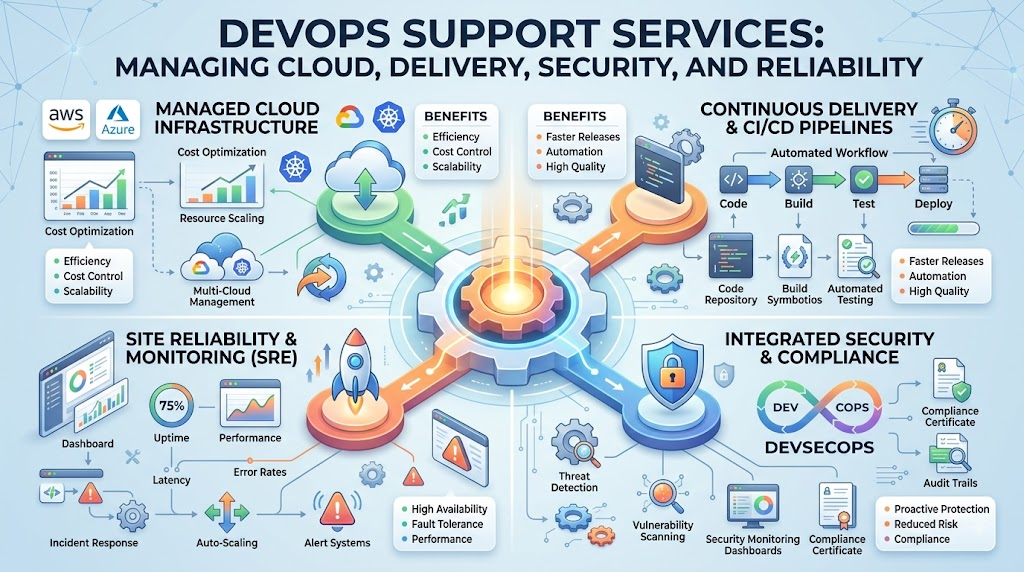
Modern software delivery depends on much more than writing code and pushing an application into production. Behind every reliable application is a collection of infrastructure, deployment pipelines, cloud resources, monitoring systems, security controls, containers, and operational processes that need regular attention. As these environments become more complex, engineering teams can find themselves spending significant time dealing with deployment errors, infrastructure changes, monitoring alerts, configuration problems, security tasks, and production incidents. Kubernetes-based platforms and multi-cloud environments can add another layer of operational responsibility. For teams with limited DevOps resources, keeping up with these activities can be difficult. This is one reason organizations consider ongoing DevOps Support Services. Rather than using DevOps only for initial implementation, continuous support provides a way to maintain, troubleshoot, automate, and improve operational environments over time. The objective is not simply to respond when something breaks. A useful support model can also help identify recurring operational issues, improve visibility, reduce manual processes, and support better coordination between development, infrastructure, security, and reliability teams.
What Does DevOps Support Actually Mean?
DevOps support is the ongoing technical work required to keep software delivery and infrastructure operations functioning effectively.
A DevOps project may initially establish a cloud environment, create CI/CD workflows, automate infrastructure provisioning, or introduce containerization. Once those systems are in use, however, they continue to require maintenance.
Applications change. Infrastructure is updated. Teams introduce new services. Deployment requirements evolve. Monitoring rules need adjustment. Security vulnerabilities are discovered. Production workloads increase.
DevOps support helps organizations handle these continuing responsibilities.
Depending on the environment, support may involve:
- Cloud infrastructure administration
- CI/CD pipeline maintenance
- Deployment assistance
- Infrastructure as Code
- Monitoring and alert investigation
- Production troubleshooting
- Automation
- Configuration management
- Incident response
- Performance optimization
The scope should be based on the organization’s actual technical environment. A small SaaS business may need assistance with a few cloud resources and deployment pipelines, while a larger organization may need support across multiple applications, clusters, and environments.
This distinction is important because DevOps implementation and DevOps support serve different purposes. Implementation creates or improves the initial environment; ongoing support helps keep that environment useful as requirements change.
Why Ongoing DevOps Support Is Becoming Important
Production systems are constantly evolving. A deployment that worked correctly last month may encounter problems after a configuration change, dependency update, infrastructure modification, or application release.
Operational teams therefore need processes for dealing with change.
Consider a company that manages its infrastructure manually. As the environment expands, small configuration differences can appear between environments. These differences may eventually result in deployment failures or unexpected application behavior.
Similarly, an organization may have monitoring in place but lack enough operational capacity to investigate every alert effectively.
Continuous support can help address areas such as:
- Infrastructure changes
- Production incidents
- Failed deployments
- Cloud resource management
- Monitoring improvements
- Security maintenance
- Scaling
- Configuration management
- Troubleshooting
- Operational automation
An external support team can supplement internal engineers by handling selected infrastructure and operational responsibilities. This allows internal developers and platform teams to focus on areas where their expertise is most valuable.
However, external support should not automatically mean transferring all technical ownership. Organizations should define which responsibilities remain internal and which are handled externally.
24/7 DevOps Support Services
A production environment can generate problems at any time. Organizations serving international users, operating critical applications, or maintaining systems across multiple time zones may need operational coverage beyond standard working hours.
24/7 DevOps Support Services can provide continuous assistance through an agreed support and escalation structure.
Depending on the arrangement, this can include:
- Infrastructure monitoring
- Alert investigation
- Production incident response
- Deployment assistance
- Troubleshooting
- Availability checks
- Emergency support
- Escalation management
However, 24/7 support should be evaluated carefully. Simply having round-the-clock personnel does not automatically create an effective incident management process.
Organizations should understand:
- Which systems are monitored
- How alerts are classified
- Who receives critical alerts
- What escalation steps are followed
- How incidents are documented
- Which issues require internal involvement
Runbooks and accurate system documentation are particularly valuable for after-hours support because engineers may need to understand unfamiliar systems quickly.
Managed DevOps Services
Managed DevOps Services involve ongoing responsibility for selected operational functions rather than providing assistance only when a specific project begins.
Depending on the organization’s needs, managed services may include:
- CI/CD administration
- Infrastructure automation
- Cloud operations
- Monitoring
- Release management
- Configuration management
- Infrastructure maintenance
- Backup operations
- Security-related tasks
This model can be useful for organizations whose infrastructure has grown faster than their internal operational capacity.
For example, a company may have a strong software development team but only a small infrastructure team. A managed arrangement can provide additional operational capacity without requiring every responsibility to be handled internally.
There are also situations where managed services may not be necessary. Organizations with mature DevOps, SRE, or platform engineering teams may prefer to retain control internally and use external specialists only for selected areas.
The decision should consider the organization’s technical maturity, workload, budget, security requirements, and desired level of control.
Kubernetes Support Services
Kubernetes provides a flexible platform for running containers, but operating it in production requires specialized knowledge.
Teams must manage clusters, workloads, networking, storage, resource allocation, security, monitoring, upgrades, and scaling. A problem in any of these areas can affect application behavior.
Kubernetes Support Services can provide assistance with:
- Cluster administration
- Version upgrades
- Workload management
- Scaling
- Networking
- Security
- Monitoring
- Resource management
- Troubleshooting
- Production optimization
These requirements can apply to platforms such as AWS EKS, Azure AKS, and Google GKE.
For example, a team may need assistance when workloads are repeatedly restarting, resources are being exhausted, network communication is failing, or a cluster upgrade needs careful planning.
Kubernetes support should not focus only on immediate problem resolution. Long-term maintainability also matters. Consistent configurations, observability, security controls, resource policies, and upgrade strategies can help reduce future operational complexity.
AWS DevOps Support Services
AWS environments can range from simple virtual-machine deployments to complex architectures involving containers, serverless applications, infrastructure automation, and distributed services.
AWS DevOps Support Services can help teams manage the operational side of these environments.
Common technologies and practices include:
- EC2
- EKS
- ECS
- Lambda
- Terraform
- CloudFormation
- CI/CD pipelines
- Cloud monitoring
- Infrastructure automation
- Deployment management
Support can involve infrastructure administration, deployment troubleshooting, pipeline maintenance, monitoring, configuration management, and production assistance.
AWS architecture should always be driven by the workload. A serverless application does not have the same operational requirements as a Kubernetes-based application, and a traditional virtual-machine environment may require a different management approach again.
Teams should therefore consider application requirements, scalability, security, cost considerations, internal skills, and long-term maintenance when making infrastructure decisions.
Azure DevOps Support Services
Azure environments also involve recurring responsibilities around infrastructure, software delivery, monitoring, and production operations.
Azure DevOps Support Services can assist with areas such as:
- Azure infrastructure
- Azure Pipelines
- AKS
- CI/CD
- Deployment automation
- Release management
- Monitoring
- Production troubleshooting
For teams already using Microsoft Azure, operational support can help manage repetitive infrastructure and delivery activities.
For example, engineers may need help maintaining deployment pipelines, investigating an AKS problem, managing infrastructure changes, or improving monitoring.
As with other cloud platforms, Azure services should be selected according to workload and organizational requirements rather than following a one-size-fits-all architecture.
DevSecOps Support Services
Security becomes harder to manage when it is separated from the development and deployment process.
DevSecOps brings security practices closer to the software delivery lifecycle. DevSecOps Support Services can help organizations integrate security checks and controls into development, CI/CD, infrastructure, and production workflows.
Relevant areas include:
- SAST
- DAST
- Dependency scanning
- Container security
- Secrets management
- Vulnerability management
- Secure CI/CD
- Security automation
- Compliance-related controls
For example, automated dependency scanning can help identify vulnerable packages, while secrets management can help prevent sensitive credentials from being stored directly in source code.
The appropriate security approach depends on the organization’s application architecture, risk profile, infrastructure, and compliance obligations.
Security should therefore be considered continuously rather than treated as a final approval step before production.
SRE Support Services
Site Reliability Engineering focuses on applying engineering practices to system reliability.
SRE Support Services can help organizations introduce structured processes for monitoring, incident management, capacity planning, and reliability improvement.
Important SRE concepts include:
- Service Level Indicators
- Service Level Objectives
- Service Level Agreements
- Error budgets
- Observability
- Incident management
- Root-cause analysis
- Capacity planning
- Performance engineering
- Reliability automation
SLIs provide measurable information about service behavior, while SLOs establish reliability objectives. Error budgets can then help teams discuss the acceptable balance between reliability and software delivery.
SRE is not about eliminating every failure. Production systems can fail even when carefully engineered. The objective is to understand reliability, detect issues effectively, learn from incidents, and make informed operational decisions.
MLOps Support Services
Machine-learning applications have operational requirements that continue after a model has been developed.
Models may need to be deployed, monitored, versioned, updated, and connected to production infrastructure. The supporting ML pipelines and computing resources also need to be managed.
MLOps Support Services can cover areas such as:
- Model deployment
- ML infrastructure
- ML pipelines
- Model monitoring
- Version management
- Automation
- Production operations
- Resource management
- Scalability
MLOps brings software engineering and operational practices into machine-learning workflows.
For instance, an organization may need repeatable processes for deploying different model versions, monitoring production models, managing ML infrastructure, and supporting model-related pipelines.
The appropriate architecture depends on the type of model, deployment environment, infrastructure, data workflow, and operational requirements.
Common Technology Areas in DevOps Support
Different teams use different tools based on their architecture and existing skills.
| Area | Common Technologies / Practices | Primary Purpose |
|---|---|---|
| CI/CD | Jenkins, GitHub Actions, GitLab CI/CD, Azure Pipelines | Automated delivery |
| Cloud | AWS, Azure, Google Cloud | Infrastructure operations |
| Containers | Docker, Kubernetes | Application consistency |
| Infrastructure as Code | Terraform, CloudFormation | Repeatable infrastructure |
| Monitoring | Metrics, logs, traces | Operational visibility |
| Security | SAST, DAST, secrets management | Secure delivery |
| SRE | SLI, SLO, error budgets | Reliability |
| MLOps | ML pipelines, model monitoring | Production ML operations |
This is a representative list rather than a complete technology catalog. Tool selection should be based on compatibility, operational requirements, security needs, and team expertise.
What Organizations Can Gain From Continuous Support
A structured DevOps support model can help address several common operational pressures.
Potential benefits include:
- Faster troubleshooting
- Less repetitive manual work
- Better infrastructure visibility
- More consistent deployments
- Improved monitoring
- More organized incident handling
- Stronger security practices
- Better cloud operations
- Improved reliability processes
- Additional support for internal engineering teams
These benefits are not automatic. A support provider needs the right system access, documentation, communication processes, and technical context to work effectively.
Organizations should therefore evaluate support as an operational partnership rather than simply purchasing additional engineering hours.
Common Challenges When Setting Up DevOps Support
1. Poor Documentation
When system architecture and operational procedures are poorly documented, engineers can spend unnecessary time understanding the environment before troubleshooting begins.
2. Unclear Responsibilities
Production ownership should be clearly defined. Teams need to know who handles deployments, infrastructure changes, incidents, and security issues.
3. Weak Escalation Processes
Critical problems require clear escalation routes so that the right engineers become involved at the appropriate time.
4. Limited Observability
Insufficient metrics, logs, and traces make it difficult to understand production behavior and identify root causes.
5. Excessive Manual Operations
Repeated manual tasks can increase operational effort and introduce configuration mistakes.
6. Configuration Inconsistency
Differences between environments can result in failures that are difficult to reproduce.
7. Communication Gaps
Support becomes less effective when incident information, changes, and findings are not communicated clearly.
8. Limited Knowledge Transfer
External engineers should document important operational information so internal teams can understand and maintain critical systems.
9. Overdependence on Providers
Organizations should avoid creating a situation where an external provider is the only party capable of understanding or operating essential infrastructure.
10. Weak Security Processes
Production access, secrets, vulnerabilities, and infrastructure modifications require appropriate security controls.
How to Evaluate a DevOps Support Company
A provider should be assessed on both technical capability and operational maturity.
Organizations can review:
- DevOps engineering expertise
- AWS and Azure experience
- Kubernetes knowledge
- Security capabilities
- SRE practices
- MLOps knowledge
- Monitoring capabilities
- Incident response
- Documentation
- Communication
- Support coverage
- Escalation procedures
- SLA structure
- Knowledge-transfer processes
- Security practices
- Collaboration with internal engineering teams
It is useful to ask practical questions before selecting a provider.
How are production changes controlled? How is privileged access managed? How are critical incidents escalated? How are root-cause findings recorded? How will internal engineers receive operational knowledge?
These questions can help organizations evaluate how a provider actually works rather than relying only on a list of technologies.
DevOps Support Areas and Business Needs
| Support Area | Typical Business Need |
| DevOps Support | Ongoing infrastructure and delivery assistance |
| 24/7 DevOps Support | Continuous monitoring and incident response |
| Managed DevOps | Management of recurring operational workloads |
| Kubernetes Support | Administration of containerized environments |
| AWS DevOps Support | AWS infrastructure and deployment management |
| Azure DevOps Support | Azure infrastructure and DevOps operations |
| DevSecOps Support | Security integration across delivery and operations |
| SRE Support | Reliability and operational improvement |
| MLOps Support | Production management of ML environments |
Frequently Asked Questions
What are DevOps Support Services?
They are ongoing technical services that assist with cloud infrastructure, CI/CD, automation, monitoring, deployments, troubleshooting, and production operations.
Why do companies need ongoing DevOps support?
Infrastructure and software environments continuously change. Support helps teams manage recurring operational tasks, infrastructure modifications, incidents, monitoring, and deployment problems.
What can 24/7 DevOps Support Services include?
Depending on the support agreement, they may include monitoring, alert investigation, incident response, troubleshooting, deployment assistance, and escalation management.
What is the difference between managed DevOps and regular support?
Regular support can address selected operational requirements, whereas managed DevOps generally covers a wider range of recurring activities such as infrastructure, CI/CD, cloud administration, monitoring, and releases.
When is Kubernetes support useful?
It can be useful when teams operate production Kubernetes clusters and need additional assistance with administration, upgrades, scaling, networking, security, monitoring, or troubleshooting.
What does AWS DevOps support involve?
It can involve EC2, EKS, ECS, Lambda, Terraform, CloudFormation, CI/CD pipelines, monitoring, infrastructure automation, and deployment operations.
How does DevSecOps support help engineering teams?
It integrates security practices into development and operations through methods such as SAST, DAST, dependency scanning, secrets management, container security, and vulnerability management.
What do SRE and MLOps support focus on?
SRE support focuses on reliability, observability, incident management, capacity, and performance. MLOps support focuses on operating ML infrastructure, pipelines, model deployment, monitoring, and production workflows.
Conclusion
DevOps is not a task that ends when an application is deployed. Infrastructure changes, software releases continue, security requirements evolve, and production systems require regular monitoring and maintenance. Ongoing support can give organizations a structured way to manage these operational responsibilities. The scope of support can be broad, covering cloud platforms, CI/CD, Kubernetes, automation, security, SRE, and MLOps. However, organizations should choose a model based on their actual environment rather than adopting every available service.
Leave a Reply