The Ultimate Guide to Bihar: Ancient Heritage, Sacred Sites, and Living Culture

September 12, 2026 · 20 reads
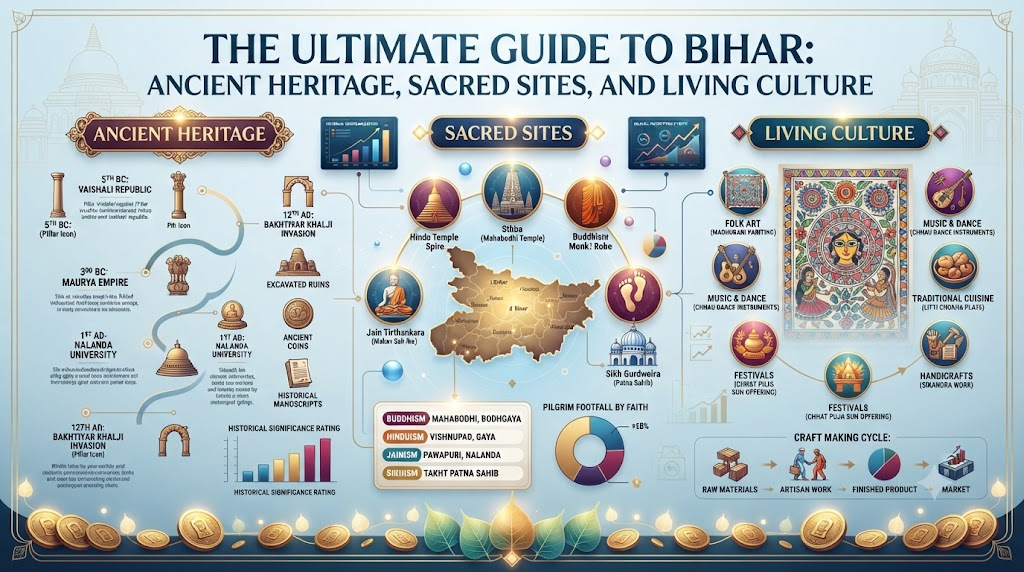
Introduction
Standing before the excavated brick foundations of an ancient monastery or beneath the canopy of a sacred tree, one realizes that travel is often less about crossing physical distances and more about peeling back centuries of human endeavor. For those fascinated by early republican governance, groundbreaking monastic scholarship, and living folk traditions, deciding where to begin a journey through eastern India can be challenging. Many travelers wonder how to experience these vast layers of history while navigating practical day-to-day transit logistics across regional roads and river basins. This field guide explores essential Bihar Tourist Places from the perspective of an immersive cultural and historical explorer. Instead of treating destinations as checkboxes, this guide looks at the historical context, architectural ingenuity, and living customs that define each stop. You will discover how to traverse the historic circuits of Bodh Gaya, Rajgir, Nalanda, Patna, and Vaishali, alongside regional culinary traditions and local customs. Independent resources such as MeraApnaBihar provide a reliable foundation for curious travelers seeking grounded, practical travel insights to plan a rewarding journey.
Understanding Bihar’s Living History: An Explorer’s Field Perspective
To understand the land historically known as Magadha, Anga, and Mithila, one must step away from modern administrative boundaries and view its geography as a canvas of early human civilization. The fertile alluvial floodplains of the Ganga River provided the agricultural wealth that sustained ancient kingdoms, while the rocky natural ramparts of Rajgir provided defensive geography for early imperial seats.
Traveling here as a culture and heritage researcher feels like an ongoing conversation with antiquity. The excavated stupas are not silent memorials; they remain active spiritual anchors for global pilgrims. The traditional arts practiced in courtyard verandas directly mirror motifs found on early terracotta seals. Navigating these destinations requires curiosity, respect, and a grounded understanding of local travel practicalities.
In-Depth Heritage Destinations: The Epicenter of Thought
1. Bodh Gaya: Geometry of Awakening
Bodh Gaya is an open-air classroom of global Buddhist architectural expression. At its core stands the towering 54-meter Mahabodhi Temple, a direct descendant of the early brick shrines built during the Gupta period.
- Historical Depth: The sanctum marks the exact spot where Siddhartha Gautama meditated beneath the pipal tree. Surrounding the main spire are thousands of votive stupas erected across several centuries by traveling pilgrims, kings, and monks.
- The Living Scene: Beyond the central monument, explore the monasteries built by communities from Japan, Thailand, Sri Lanka, Bhutan, and Myanmar. Each temple displays its native architectural motifs—from Japanese cedar carpentry to the multi-tiered eaves of Thai stupas.
- Explorer Tip: Gaya Junction serves as the main railway hub (around 16 km away). Arrive in the inner sanctum at dawn when morning chants echo against stone walls, avoiding the midday heat.
2. Nalanda: The Architecture of Global Intellect
Walking into the excavated ruins of Nalanda Mahavihara is a humbling experience. Established in the 5th century CE under the patronage of the Gupta emperors, this institution accommodated thousands of scholars from China, Korea, Central Asia, and Tibet.
- Architectural Ingenuity: The complex reveals advanced civic planning. Monasteries feature central open courtyards bordered by residential meditation cells, independent water wells, granaries, and subterranean drainage systems.
- Site Highlights: Site No. 3 showcases towering corner stupas adorned with stucco panels of the Buddha and Bodhisattvas. The adjacent museum houses recovered seals, bronze idols, and copper-plate grants.
- Transit Note: Located just 12 km from Rajgir, Nalanda can be easily reached by a short auto-rickshaw or taxi ride through quiet agricultural landscapes.
3. Rajgir: The Citadel Within the Hills
Surrounded by the five hills of Ratnagiri, Vipulagiri, Vaibhargiri, Songiri, and Udaygiri, Rajgir served as the fortified heart of early Magadha.
- Strategic Geography: King Bimbisara and Ajatashatru built cyclopean stone walls spanning over 40 km across these rocky crests, using massive dry-stone masonry that endures today.
- Spiritual Intersections: Rajgir is sacred across traditions. Gridhakuta (Vulture’s Peak) was the setting for many of the Buddha’s Lotus Sutra discourses. Nearby, the Sonbhandar caves reflect early ascetic dwellings, while the hot mineral springs at the base of the hills have drawn bathers for centuries.
- Explorer Tip: Take the aerial chairlift up Ratnagiri Hill to the Vishwa Shanti Stupa, or walk the forest trails early in the morning to appreciate the natural isolation of this valley.
4. Patna: Pataliputra’s Layered Capital
Modern Patna stands directly over the ancient Mauryan and Gupta imperial capital of Pataliputra. While modern urbanization has covered much of the ancient city, its historical importance remains palpable.
- The Bihar Museum: A necessary starting point for any serious heritage trip. The museum houses masterworks such as the 3rd-century BCE Didarganj Yakshi, exquisite Kurkihar bronzes, and comprehensive ethnographic galleries dedicated to indigenous crafts.
- Sacred Urban Heritage: Takht Sri Patna Sahib, located in the narrow lanes of old Patna, marks the birthplace of Guru Gobind Singh Ji. The gurdwara preserves historic relics, holy scriptures, and continuous community kitchen (langar) traditions.
- Riverfront Heritage: Walk along the old riverfront ghats at sunset to observe how daily life, spiritual rituals, and seasonal river currents have coexisted for millennia.
5. Vaishali: Cradle of Democratic Assemblies
Cross the Mahatma Gandhi Setu over the Ganga to enter Vaishali, the historic capital of the Lichchhavi republic.
- Significance: Here, the early Licchavis conducted public affairs in open parliament assemblies. It is also where Gautama Buddha delivered his final sermon, and where Lord Mahavira was born.
- What to Examine: The remarkably intact Ashokan Pillar at Kolhua, carved from a single block of polished Chunar sandstone and crowned by a seated lion. Beside it sits the brick relic stupa where the Lichchhavis interred their share of the Buddha’s ashes.
Curated Heritage Circuits for Cultural Travelers
Organizing travel by geographical proximity helps minimize road fatigue and maximizes time spent studying monuments.
| Heritage Route | Highlighted Locations | Suggested Pace | Focus for Culture Lovers | Major Transit Base |
| The Classical Magadha Trail | Bodh Gaya, Rajgir, Nalanda, Pawapuri | 4–5 Days | Monastic history, rock-cut architecture, early philosophy | Gaya / Rajgir |
| The Mauryan & Gangetic Circuit | Patna, Vaishali, Kesariya | 3–4 Days | Imperial politics, Ashokan pillars, grand stupas | Patna |
| The Mithila Art & Palace Trail | Darbhanga, Madhubani, Saurath | 3–4 Days | Folk painting, Raj Darbhanga architecture, living craft | Darbhanga |
| Western Forts & Tombs Trail | Sasaram, Rohtasgarh, Kaimur | 2–3 Days | Sher Shah Suri’s tomb, medieval hill forts, waterfalls | Sasaram |
Things to Do in Bihar: Immersion into Living Arts
To truly connect with regional heritage, engage directly with working artisans and traditional cultural spaces:
- Visit Artisan Clusters in Madhubani: Travel to villages such as Jitwarpur and Ranti to sit with women artists who continue the tradition of painting mythological tales and nature motifs on handmade paper using bamboo twigs.
- Observe Bhagalpuri Silk Processing: Explore the traditional handlooms of Champanagar near Bhagalpur, where weavers transform native Tussar silk cocoons into lustrous, textured textiles.
- Study Stone Sculptures in Gaya: Walk through traditional stone-carving workshops around the foot of the hills where artisans sculpt granite and chlorite using ancestral chiseling techniques.
- Hike to Ancient Hermitages: Climb the stone steps to the Barabar Caves in Jehanabad to marvel at the earliest surviving rock-cut chambers in India, carved with mirror-like interior polishes during the Mauryan era.
- Experience Evening Ganga Aarti in Patna: Join local residents along the ghats as traditional brass lamps and devotional hymns bring the riverbank to life.
Bihar Culture and Heritage: Deep Roots of Folk Art and Craft
Art in this region was never confined to royal courts; it developed primarily within rural households and village courtyards.
- Madhubani (Mithila) Art: Characterized by geometric line drawings, two-dimensional planes, and natural vegetable dyes derived from madder, turmeric, and indigo. The styles vary across sub-traditions, including Bharni, Kachni, and Godna.
- Manjusha Art: Originating from the ancient Anga kingdom around Bhagalpur, this narrative line art uses a strict three-color palette (pink, green, and yellow) to depict the folklore of Bihula and Bishahari on scrolls and paper boxes.
- Sikki Grass Weaving: A domestic craft where golden-hued wild river grass (Sikki) is split and coiled into storage baskets, toys, and ritual figures, showcasing remarkable ecological resourcefulness.
Famous Food of Bihar: A Culinary Anthropologist’s Plate
Traditional culinary preparations reflect regional soil types, agrarian work rhythms, and seasonal climates. Minimalist spices and roasting techniques take precedence over heavy gravies.
- Litti Chokha: A rustic staple forged in rural fields. Dough balls made from whole-wheat flour are packed with sattu (roasted chickpea flour enriched with carom seeds, nigella seeds, crushed garlic, and aged mustard oil). Roasted slowly over cow-dung cake embers, broken open, and dipped in warm ghee, they are paired with roasted mashed eggplant, tomatoes, and boiled potatoes.
- Silao Ka Khaja: A historic confection created between Nalanda and Rajgir. It features paper-thin layers of wheat flour fried crisp and dipped in mild sugar syrup, yielding a delicate, melt-in-the-mouth texture.
- Dal Pitha: Steamed dumplings of rice-flour dough stuffed with coarse, spiced chana dal, representing an ancient culinary practice of steaming rather than frying.
- Gaya’s Winter Confections: The craft of pounding sesame seeds with boiled jaggery to produce brittle, wafer-like Tilkut is an art perfected by generations of sweet-makers in Gaya’s narrow bazaars.
Living Traditions: Festivals of Bihar
Cultural festivals here revolve around nature worship, seasonal transitions, and deep community equity.
- Chhath Puja: This ancient festival stands out for its lack of priestly mediation. Families assemble as equals along the riverbanks to honor Surya (the Sun) and Chhathi Maiya. Devotees offer arghya of seasonal produce, sugarcane, and freshly pressed thekua to both the setting and rising sun, symbolizing the cycle of life.
- Makar Sankranti: Celebrated in mid-January, honoring the harvest through communal meals of chuda-dahi (beaten rice with thick clay-pot curd) paired with fresh winter jaggery and sesame sweets.
- Sonepur Mela: Situated at the meeting point of the Ganga and Gandak rivers, this historic fair combines rural commerce, livestock trade, and spiritual bathing during Kartik Purnima, keeping an age-old trade tradition alive.
Practical Travel Logistics and Seasonality
Ideal Exploration Window
- October to March: The optimal travel window for cultural exploration. Days are pleasantly crisp (15°C to 24°C), allowing comfortable walking through extensive archaeological sites like Nalanda and Sasaram.
- April to June: High temperatures require that all heritage walks occur between 6:00 AM and 9:30 AM, reserving the hot afternoons for indoor museums.
- July to September: The landscape turns lush and green, but sudden downpours can slow highway travel.
Getting Around
- Air Travel: Patna (PAT) is the primary gateway with frequent domestic connections. Darbhanga (DGB) serves northern districts, while Gaya (GAY) hosts selective domestic and seasonal international flights.
- Rail Connectivity: The rail network is an efficient and affordable way to travel. Gaya, Patna Junction, and Pt. Deen Dayal Upadhyaya Junction connect directly to major hubs across India.
- Roads: Well-paved national and state highways link Patna with Rajgir, Gaya, and Vaishali. Hiring a dedicated cab from Patna remains the most practical method for customized multi-site travel.
Ethical Travel and Site Conservation
- Protect Ancient Brickwork: Ancient terracotta and burnt-brick courses at Nalanda, Vaishali, and Vikramshila are fragile. Never climb excavated walls, remove small fragments, or step inside cordoned-off sanctums.
- Respect Sacred Rituals: Monasteries and river ghats are active spaces of faith. Always ask permission before photographing ceremonies, and circumambulate Buddhist stupas in a respectful clockwise manner.
- Support Local Crafts: Purchase handloom fabrics, Sikki baskets, and folk paintings directly from artisan collectives or government craft emporiums to ensure your travel expenditure directly supports traditional communities.
Practical Travel Example: 3-Day Heritage & Art Itinerary
Scenario: A solo cultural traveler wants to study ancient architecture and folk art over an intensive long weekend.
- Day 1: The Foundations of Magadha (Nalanda & Rajgir)
- Take an early-morning train or private cab from Patna to Nalanda.
- Spend 3 hours exploring the monasteries, stupas, and archaeological museum with an ASI-licensed guide.
- Transfer to Rajgir; pause in Silao to watch the preparation of traditional Khaja.
- Ride the ropeway up Ratnagiri Hill to examine the Peace Pagoda and enjoy panoramic views over the ancient valley.
- Overnight stay in Rajgir or Bodh Gaya.
- Day 2: Sacred Architecture in Bodh Gaya
- Early-morning visit to the Mahabodhi Temple for meditation and study of the stone railings and votive stupas.
- Midday walking tour of the diverse international monasteries to compare Buddhist temple architecture.
- Evening visit to nearby Sujata Kuti and the banks of the Phalgu River.
- Dinner featuring authentic regional dishes at a quiet local eatery.
- Day 3: Patna’s Antiquities & Departures
- Morning road transfer back to Patna.
- Dedicate 2 to 3 hours to the ancient stone galleries and terracotta collections at the Bihar Museum.
- Visit Takht Sri Patna Sahib in the old city to experience the historic community space.
- Evening transfer to Patna Airport or railway station for onward departure.
Key Takeaways
- Treat your journey across Bihar as an immersive historical study rather than a hurried sightseeing checklist.
- The cool winter months between October and March offer the best conditions for walking open archaeological sites.
- Choose a dependable transit base such as Patna or Gaya to explore surrounding heritage circuits without constant hotel changes.
- Take time to experience living crafts like Madhubani painting and Bhagalpuri silk weaving directly in artisan villages.
- Respect monument conservation rules by not touching ancient surfaces and observing monastery etiquette.
- Enjoy authentic culinary traditions like charcoal-roasted Litti Chokha and Silao Khaja from clean, reputable local spots.
Frequently Asked Questions
What makes Bihar Tourist Places distinctive for history and culture enthusiasts?
The region is an epicenter of foundational world philosophies, ancient democratic experiments, and early institutional education. Within a compact geographical radius, travelers can explore early Buddhist and Jain monastic hubs, Mauryan rock-cut architecture, and intact medieval monuments, making it a uniquely rewarding landscape for cultural study.
Which archaeological sites in Bihar are inscribed as UNESCO World Heritage Sites?
Currently, the Mahabodhi Temple Complex at Bodh Gaya and the Archaeological Site of Nalanda Mahavihara at Nalanda hold UNESCO World Heritage status. Both locations showcase sophisticated ancient brick architecture, sculpture, and religious heritage.
How accessible is local transportation between major heritage towns?
Major tourist hubs like Patna, Gaya, Rajgir, and Nalanda are well connected by four-lane highways and regional passenger trains. Hiring an intercity taxi or booking air-conditioned state transport buses provides reliable point-to-point transit across the central heritage circuit.
What should travelers keep in mind when visiting Buddhist monasteries?
Travelers should remove footwear before entering prayer halls, avoid loud speech, circumambulate stupas clockwise, and dress with shoulders and knees covered. Turn off camera flashes inside meditation sanctums and confirm photography rules with the resident monks.
What is the significance of the Barabar Caves for architectural history?
Located in Jehanabad district, the Barabar Caves are the oldest surviving rock-cut chambers in India, dating back to the Mauryan Empire under Emperor Ashoka. They are famous for their mirror-like interior stone polish and early imitation of wooden barrel-vaulted architecture.
Are licensed guides available at the major archaeological ruins?
Yes, certified guides registered with the Archaeological Survey of India (ASI) or the Ministry of Tourism are available at primary locations like Nalanda, Bodh Gaya, and Vaishali. Confirm their official credentials and agree upon standard charges at the ticket counter before beginning your tour.
What regional handicrafts are best to collect during a cultural journey?
Hand-painted Madhubani canvases, Bhagalpuri raw Tussar silk fabrics, fine Sikki grass decorative baskets, and traditional stone carvings from Gaya make authentic, valuable souvenirs. Buying directly from artisan cooperatives ensures your money supports local craft traditions.
How does traditional Bihari food accommodate vegetarian travelers?
Traditional food in the region is predominantly vegetarian and emphasizes plant-based protein from lentils and roasted gram flour. Staples like Litti Chokha, Dal Pitha, Sattu drinks, and seasonal vegetable preparations offer nutritious, flavorful options for vegetarian travelers.
What precautions should travelers take when visiting outdoor ruins in warmer months?
During summer, visit open excavation sites early in the morning between 6:30 AM and 9:30 AM. Carry a wide-brimmed hat, apply sun protection, and drink plenty of electrolyte water or fresh sattu sherbet to avoid dehydration.
Where can visitors track local updates, festivals, and travel information for Bihar?
Travelers should consult official state tourism advisories, regional district administration portals, and informational local travel platforms like MeraApnaBihar. These resources offer verified updates on cultural festivals, seasonal events, and route guidelines to help plan a smooth journey.
Conclusion
Approaching Bihar through the lens of a cultural explorer reveals a region of extraordinary historical significance. Its ancient monuments, rock-cut chambers, and riverfronts are not just relics of the past—they represent active centers of living philosophy, artisan traditions, and enduring local customs. By traveling with patience, engaging with local communities, respecting conservation guidelines, and embracing regional culinary heritage, visitors gain a genuine appreciation for the roots of classical Indian civilization. As you plan your itinerary, rely on dependable local resources like MeraApnaBihar to ensure your journey through this historic heartland is safe, organized, and deeply enriching.
Leave a Reply