Strategic FinOps Foundation Certification: Building Cloud Financial Accountability

August 17, 2026 · 23 reads
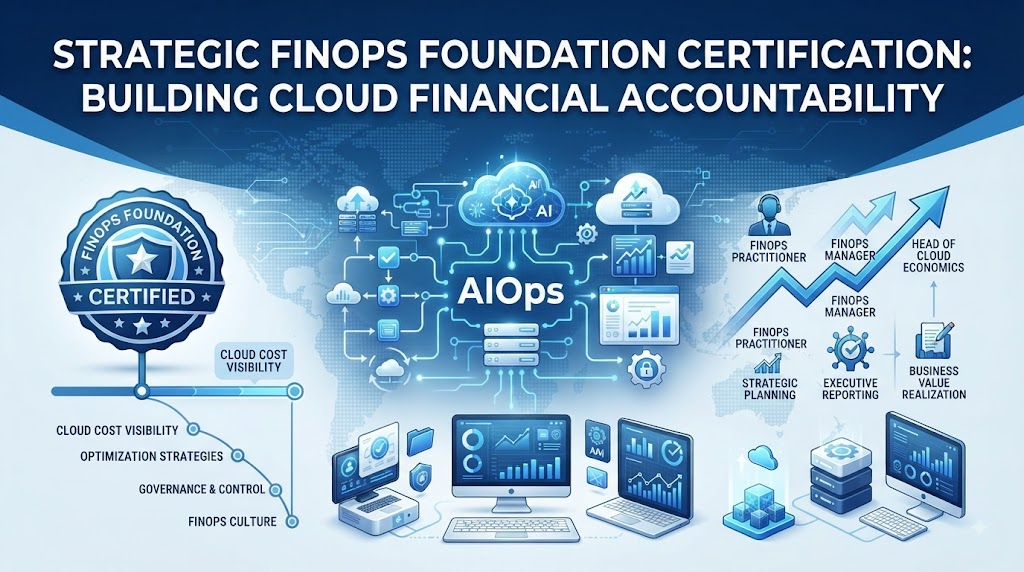
Cloud computing enables teams to launch infrastructure, applications, data platforms, and AI workloads quickly. However, the same flexibility can make technology spending difficult to understand, allocate, forecast, and optimize. FinOps Foundation Certification learning paths help professionals build a shared language for managing technology costs while protecting the speed, reliability, and business outcomes that cloud services enable. FinOps—short for Financial Operations—is a collaborative practice that connects engineering, finance, procurement, and business teams. It focuses on making informed, value-driven technology decisions rather than treating cloud cost reduction as the only objective. This guide explains FinOps, the FinOps Foundation, certification and learning considerations, the FinOps Framework, practical skills, career relevance, and preparation strategies.
What Is FinOps Foundation Certification?
FinOps Foundation Certification refers to the FinOps Foundation’s professional education and certification programs, which validate knowledge of FinOps practices and cloud financial management. The exact learning options and eligibility rules vary by program, so candidates should always confirm current details through the Foundation’s official training catalog and learning portal. The Foundation offers multiple training and certification opportunities, including foundational and specialized learning areas.finops+1
The purpose of certification is not simply to teach people how to reduce a cloud bill. It helps learners understand how organizations can create accountability for technology spending, improve visibility into usage and cost, and connect investment decisions with business value.
A FinOps credential can support professional development by helping a cloud engineer understand finance-oriented metrics, helping a finance professional understand variable cloud consumption, or helping a technology leader establish better operating practices across teams. It does not guarantee a job, promotion, or salary outcome; its value depends on the person’s experience, practical application, and organizational context.
What Is FinOps?
FinOps is an operating practice for maximizing the business value of technology spending through collaboration among engineering, finance, and business teams. It applies especially well to cloud environments, where costs can change rapidly based on consumption.
In simple terms, FinOps helps an organization answer questions such as:
- Who is using cloud resources and why?
- Which products, teams, customers, or environments create the spending?
- Is the organization receiving enough business value for that spend?
- Where can teams reduce waste without harming performance or delivery speed?
- How can future cloud spending be forecast more accurately?
FinOps is not owned only by finance. Engineering teams need timely cost and usage data to make technical choices; finance teams need reliable forecasting and allocation; business leaders need a view of value, priorities, and outcomes. The FinOps Framework emphasizes collaboration, ownership, accurate and timely data, centralized enablement, and business-value-driven decisions.learn.microsoft+1
Why FinOps Matters
Cloud pricing is dynamic. Organizations may pay differently depending on usage volume, regions, storage patterns, data transfer, commitment discounts, licensing, managed services, and workload architecture. Without clear practices, teams can create unexpected costs through idle resources, oversized instances, unallocated spend, duplicate tools, or poor governance.
FinOps is important because it supports:
- Cloud cost visibility: Teams can see spending by account, subscription, project, product, environment, owner, or cost center.
- Cost control: Teams can detect abnormal spend and remove waste before it becomes a larger issue.
- Budget management: Stakeholders can compare actual spending with budgets and adjust plans early.
- Forecasting: Finance and engineering can use consumption data to develop better forecasts.
- Resource optimization: Teams can rightsize compute, manage storage lifecycle rules, schedule non-production workloads, and evaluate commitments.
- Better decisions: Cost becomes one factor among performance, reliability, security, delivery speed, and customer value.
- Financial accountability: The people who make technology consumption decisions can understand their financial impact.
- Cross-functional collaboration: Finance and technical teams operate from shared data and common goals.
A mature FinOps practice therefore focuses on business value—not indiscriminate cost cutting.
About the FinOps Foundation
The FinOps Foundation is a community organization focused on advancing FinOps practices, education, standards, and collaboration across the technology industry. Its FinOps Framework provides an operating model and common language for organizations seeking to manage cloud and broader technology spending effectively.finops+1
The Foundation contributes to the FinOps ecosystem through:
- The FinOps Framework and related guidance
- Training and certification programs
- Community learning and practitioner resources
- Shared practices for cost allocation, forecasting, optimization, and governance
- Work related to standards such as FOCUS, the FinOps Open Cost and Usage Specification
- Guidance that extends beyond public cloud into areas such as SaaS, data centers, data platforms, containers, and AI-related technology spendingfinops+1
This broader approach matters because technology value management increasingly includes more than a single public-cloud invoice.
Certification Structure and Eligibility
The FinOps Foundation maintains several training and certification options, including FinOps Certified Practitioner and more specialized programs. Current training FAQs also describe certification paths that may have specific requirements, such as holding active credentials or earning required learning badges before becoming eligible for certain advanced assessments.finops+1
Because formats, pricing, retake policies, validity periods, and prerequisites can change, do not rely on third-party summaries as the final source of truth. Review official FinOps Foundation training information before registering.
Recommended background
For foundational FinOps learning, useful preparation includes:
- Basic cloud computing concepts, such as accounts, subscriptions, projects, regions, compute, storage, and networking
- Familiarity with cloud billing and consumption-based pricing
- Awareness of budgets, financial reporting, or forecasting
- Exposure to engineering, operations, finance, procurement, or IT management workflows
- Interest in collaboration between technical and business teams
Formal prerequisites depend on the individual program. Recommended knowledge is different from an official requirement: someone may be eligible to enroll while still benefiting from additional cloud or financial fundamentals first.
Skills and topics to learn
A strong FinOps learner should understand both financial and operational concepts. The following table describes commonly relevant learning areas; it is not an official exam syllabus for every certification.
| Topic | What learners should understand | Practical application |
|---|---|---|
| Cloud economics | Variable pricing, consumption, commitments, discounts, and trade-offs | Choosing an appropriate compute or pricing model |
| Cost allocation | Tags, labels, accounts, projects, cost centers, and shared-cost methods | Assigning spend to products or teams |
| Cost visibility | Billing data, dashboards, reporting, anomaly detection | Finding unexpected cost changes |
| Optimization | Rightsizing, scheduling, storage optimization, commitment management | Reducing waste while maintaining service quality |
| Budgeting | Budget ownership, alerts, variance analysis | Acting when a product exceeds its planned spend |
| Forecasting | Trend analysis, planned growth, usage drivers, uncertainty | Estimating next-quarter cloud cost |
| Governance | Policies, accountability, workflows, controls, and KPIs | Establishing review processes for high-cost resources |
| Business value | Unit cost, product economics, customer outcomes, performance trade-offs | Linking spend to revenue, adoption, or service outcomes |
| Collaboration | Communication between finance, engineering, and leadership | Reviewing shared cost data and actions |
The FinOps Framework Explained
The FinOps Framework provides building blocks for establishing and improving a FinOps practice. It includes principles, personas, domains, capabilities, measures of success, maturity characteristics, and functional activities that help organizations create a common operating model.
The framework is useful because FinOps is not a one-time cost-reduction project. Different people perform different activities: engineers may optimize workloads, finance teams may forecast spend, FinOps practitioners may improve allocation and reporting, while leadership sets priorities and evaluates value.
FinOps principles
The framework’s principles guide how teams behave and make decisions. In practical terms, they include the following ideas:
- Teams collaborate across engineering, finance, procurement, and business functions.
- Technology decisions are driven by business value, not cost alone.
- People take ownership for the technology usage they influence.
- FinOps data should be accessible, timely, and accurate.
- FinOps practices should be enabled centrally for consistency and scale.
- Organizations should use the cloud’s variable-cost model to make continuous improvements.learn.microsoft+1
For example, a platform team may identify that development environments run all night. Rather than finance simply demanding lower spend, the FinOps process can show the cost, confirm development needs, and help the engineering team schedule non-production resources outside working hours.
FinOps lifecycle
The currently recognized FinOps lifecycle has three iterative phases: Inform, Optimize, and Operate. These are not linear steps that happen once; organizations cycle through them continuously.finops
- Inform: Create visibility into technology use and cost. This includes allocation, reporting, budgeting, forecasting, benchmarking, and stakeholder communication.
- Optimize: Identify and prioritize opportunities to improve efficiency and value. Examples include rightsizing, removing unused resources, selecting suitable commitment options, and improving architecture.
- Operate: Put the practice into repeatable operation through governance, KPIs, policies, accountability, and ongoing measurement of outcomes.
The output of one phase informs the next. A team may discover a cost trend during Inform, test an optimization in Optimize, and then embed alerts and ownership processes in Operate.
Tools, use cases, and projects
FinOps practitioners commonly use cloud-provider cost-management services, billing exports, data warehouses, dashboards, tagging or labeling systems, budget alerts, anomaly-detection tools, infrastructure-as-code workflows, and governance platforms. Tool selection should follow the organization’s cloud estate, data maturity, security needs, and reporting requirements.
Common use cases include:
- Building cost allocation for products, teams, or customer-facing services
- Investigating an unexpected month-over-month spending increase
- Rightsizing compute based on utilization and performance data
- Managing multi-cloud reporting through normalized cost data
- Forecasting spend for a product launch or new data workload
- Tracking unit economics, such as cloud cost per transaction, active user, or customer
- Measuring the financial effect of engineering optimization work
Hands-on projects
Practical work helps turn FinOps vocabulary into usable skills:
- Create a monthly cloud spend dashboard by service, account, and environment.
- Design a tag or label standard that assigns resources to owners and cost centers.
- Build a budget-versus-actual report with variance explanations.
- Audit a sample cloud environment for idle storage, stopped resources, or oversized compute.
- Create a simple forecast using historical usage and planned workload growth.
- Define a unit-cost metric, such as infrastructure cost per order processed.
Preparation roadmap
A practical FinOps Foundation Certification preparation plan can look like this:
- Learn cloud billing fundamentals and common pricing models.
- Study core FinOps concepts, including allocation, visibility, optimization, forecasting, and governance.
- Read the current FinOps Framework, including its principles and lifecycle.
- Review official FinOps Foundation training pages, course materials, and certification requirements.
- Practice interpreting billing data and explaining cost changes in business terms.
- Complete a hands-on project involving reporting, allocation, optimization, or forecasting.
- Review weak areas, especially cloud economics and cross-functional decision-making.
- Prepare for the relevant assessment using the official scope and current guidance.
Avoid memorizing terminology without understanding the trade-offs behind it. Another common mistake is focusing only on infrastructure optimization while ignoring allocation, forecasting, business value, and stakeholder communication.
Career paths and related learning
FinOps knowledge is relevant to roles such as FinOps Practitioner, FinOps Analyst, FinOps Engineer, Cloud Cost Analyst, Cloud Financial Management Professional, Cloud Architect, Cloud Consultant, Platform Engineer, DevOps Engineer, and technology leader.
Salary and career progression vary substantially by experience, geography, cloud expertise, industry, organization size, technical depth, and responsibility. A certification may strengthen a professional profile, but real-world experience with billing data, optimization programs, and stakeholder collaboration is equally important.
| Certification / Path | Main focus | Best for | Key skills |
|---|---|---|---|
| FinOps Foundation learning | Technology value and cloud financial management | Cloud, finance, and business professionals | Allocation, forecasting, optimization, governance |
| Cloud certifications | Cloud platform services and architecture | Engineers and architects | Compute, storage, networking, security, platform design |
| DevOps learning | Delivery automation and operations | Developers, SREs, platform engineers | CI/CD, observability, automation, reliability |
| Cloud architecture paths | Designing scalable cloud systems | Architects and senior engineers | Architecture trade-offs, resilience, security, cost awareness |
| Data and analytics paths | Data systems and analytics | Data engineers and analysts | Data pipelines, reporting, governance, analysis |
After a foundational FinOps credential, learners can specialize in cloud engineering, platform engineering, cloud architecture, FinOps data and reporting, procurement, cloud consulting, or broader technology value management.
Future of FinOps
FinOps is expanding as organizations manage costs across multi-cloud environments, SaaS, data platforms, containers, and AI workloads. The FinOps Foundation’s evolving framework reflects broader technology-value management and updated scopes for different categories of technology spend.finops+1
Important trends include AI-assisted optimization, automated cost controls, stronger unit-economics measurement, cloud sustainability considerations, normalized cost data, and closer collaboration between FinOps and platform engineering. The enduring goal remains the same: help organizations make better technology decisions by connecting cost, usage, and business value.
FAQs
What is FinOps Foundation Certification?
FinOps Foundation Certification refers to credentials and learning programs focused on FinOps practices, cloud financial management, technology cost visibility, optimization, and business-value-driven decision-making.
What does FinOps mean in cloud computing?
FinOps is a collaborative operating practice that helps engineering, finance, and business teams manage variable technology spending and maximize business value.
Who should take a FinOps certification?
FinOps learning can help cloud engineers, DevOps engineers, architects, finance professionals, IT managers, consultants, FinOps practitioners, and technology leaders. Suitability depends on career goals and prior knowledge.
Are there prerequisites for FinOps Foundation Certification?
Requirements vary by program. Foundational learning generally benefits from basic cloud and billing knowledge, while advanced credentials may have specific official eligibility conditions. Check the current official program page before enrolling.
Is FinOps only about reducing cloud costs?
No. FinOps aims to improve the value of technology spending. Cost reduction may be an outcome, but teams also consider reliability, performance, speed, product goals, and business outcomes.
How does the FinOps Framework work?
The framework provides common principles, personas, capabilities, and lifecycle phases that organizations can use to establish and improve their FinOps practice.finops+1
What are the three FinOps lifecycle phases?
The three iterative phases are Inform, Optimize, and Operate.
How can I prepare for a FinOps certification assessment?
Start with cloud billing fundamentals, study the current FinOps Framework, use official learning materials, practice cost-analysis scenarios, and complete hands-on reporting or optimization projects.
What skills do FinOps professionals need?
They need skills in cloud cost visibility, allocation, optimization, budgeting, forecasting, reporting, cloud economics, governance, and communication across technical and business functions.
Can finance professionals learn FinOps?
Yes. Finance professionals can gain useful context about cloud consumption, billing data, forecasting, allocation, and the technical decisions that influence variable technology costs.
What tools are used in FinOps?
Common categories include cloud-provider cost-management tools, billing-data platforms, dashboards, forecasting systems, allocation tools, anomaly detection, governance tools, and infrastructure automation.
Does FinOps certification guarantee a job?
No. Certification can demonstrate structured knowledge, but hiring outcomes depend on experience, technical skills, communication ability, market conditions, and the requirements of a specific role.
How does FinOps support cloud cost optimization?
FinOps helps teams identify waste, understand usage patterns, prioritize actions, assign ownership, and measure the impact of optimization decisions against business objectives.
What should I learn after a FinOps certification?
Your next step can depend on your goals: cloud architecture, DevOps, platform engineering, data analytics, cloud consulting, advanced FinOps practices, or technology value management are all relevant directions.
Conclusion
FinOps Foundation Certification can be a valuable part of a cloud financial management learning journey for professionals who need to connect technology spending with business value. FinOps brings finance, engineering, and business teams together around timely data, shared accountability, thoughtful optimization, and better decision-making. The most effective approach combines official learning resources with practical experience. By studying the FinOps Framework, working with cloud cost data, building allocation and forecasting skills, and practicing real-world optimization scenarios, learners can develop capabilities that remain relevant as cloud and broader technology spending continue to evolve.
Leave a Reply