Knee Arthroscopy vs Knee Replacement: Understanding the Difference

September 11, 2026 · 17 reads
Introduction
Watching a parent, spouse, or close family member struggle with chronic knee stiffness transforms everyday life for the entire household. When joint damage begins dictating daily routines, simple outings, and family gatherings, joint replacement frequently shifts from a distant consideration to an active discussion. For family members and patient advocates, selecting the best hospital for knee replacement means looking past polished promotional material to examine objective clinical safeguards, surgical team experience, and post-discharge physical rehabilitation systems. Navigating these healthcare choices requires evaluating procedural nuances, infection-control standards, and practical recovery demands. Informational platforms like KneeHospitals.com support families during this decision-making process by outlining treatment pathways and hospital capabilities. This guide provides caregivers and loved ones with practical tools to assess orthopedic departments, understand surgical distinctions, clarify financial details, and support a smooth, well-organized recovery journey from day one.
Understanding Knee Replacement: The Clinical Basics for Families
When supporting a relative through joint surgery discussions, understanding the underlying procedure helps remove uncertainty and clarifies what the surgeon aims to achieve. Knee replacement, clinically termed knee arthroplasty, is fundamentally a joint resurfacing procedure rather than a total amputation of biological structures.
During surgery, the specialist carefully trims worn, degraded articular cartilage and bone contours at the junction of the femur (thighbone) and tibia (shinbone). The surgeon then secures biocompatible metal alloys and a medical-grade polyethylene spacer to create a stable, low-friction gliding surface. In many cases, the posterior surface of the patella (kneecap) is also resurfaced with a smooth polyethylene button.
Depending on the extent of your family member’s joint wear, the orthopedic specialist will recommend one of two surgical configurations:
- Total Knee Replacement (TKR): The surgical team addresses all three compartments of the knee: the medial (inner), lateral (outer), and patellofemoral (front/kneecap) compartments. This approach is recommended when structural wear is widespread or when significant joint deformity is present.
- Partial Knee Replacement (PKR): Often referred to as unicompartmental knee replacement, this procedure targets only the single damaged section, preserving healthy native bone, cartilage, and both cruciate ligaments (ACL and PCL) in the remainder of the joint.
Caregivers should understand that both procedures aim to realign the mechanical axis of the limb, correct joint deformity, and relieve bone-on-bone friction, allowing patients to regain mobility.
Causes, Functional Limitations, and Warning Signs
Joint deterioration rarely appears overnight; it typically progresses over years, gradually narrowing a person’s daily life. Families often recognize the cumulative impact before the patient acknowledges the full severity.
Primary Conditions Underlying Severe Joint Damage
- Degenerative Osteoarthritis: The primary driver of age-related joint decline, marked by progressive cartilage loss, localized bone spur formation, and joint space narrowing.
- Inflammatory and Autoimmune Arthritis: Systemic conditions such as rheumatoid arthritis or psoriatic arthritis that cause persistent inflammation of the synovial membrane, breaking down joint structures over time.
- Post-Traumatic Degeneration: Accelerated arthritis developing years after high-energy fractures, extensive meniscus damage, or prior ligament ruptures.
Signs Families Should Watch For
Family members should encourage a specialist consultation when observing:
- Noticeable reluctance to walk short distances, shop, or attend social events due to pain
- Worsening joint stiffness in the morning or after sitting, requiring substantial time to loosen up
- Disturbed sleep patterns caused by joint aching during changes in resting position
- Visible structural changes, such as inward bowing (varus) or outward angling (valgus) of the legs
- Frequent joint buckling, catching, or feelings of mechanical instability that raise fall risks
- Persistent swelling around the joint that no longer responds to elevation or anti-inflammatory medications
How Specialists Evaluate Joint Health: What to Expect at Consultations
Accompanying your loved one to clinical appointments ensures critical diagnostic details are noted and reviewed. A comprehensive orthopedic evaluation includes multiple assessments:
- Comprehensive Clinical History: The physician reviews symptom history, previous non-surgical treatments, systemic health factors (such as heart conditions, diabetes, or kidney function), and personal activity goals.
- Hands-on Physical Assessment: The doctor evaluates joint alignment, soft-tissue stability, passive and active range of motion, muscle strength in the quadriceps and calf, and gait abnormalities.
- Weight-Bearing Radiographs: Standard X-rays taken while standing are essential. They demonstrate how gravity compresses the joint space, revealing bone-on-bone contact and mechanical misalignments that lie hidden during non-weight-bearing scans.
- Magnetic Resonance Imaging (MRI): Useful in non-standard presentations to evaluate underlying soft-tissue integrity, subchondral bone health, and the condition of the cruciate ligaments when partial knee replacement is evaluated.
- Pre-Operative Systemic Screening: Laboratory blood testing, urinalysis, cardiac clearance, and nasal swabs for bacteria help verify surgical safety and minimize infection risks.
Conservative Therapies: Exploring Non-Surgical Options First
Families often wonder whether surgery can be safely postponed or avoided altogether. Before scheduling an operation, reputable orthopedic teams evaluate whether structured non-surgical care can provide adequate relief.
- Focused Physical Therapy: Working with a licensed physical therapist strengthens the quadriceps, hamstrings, and hip stabilizers, helping offload mechanical stress from the joint surfaces.
- Structured Weight Optimization: Reducing overall body mass directly lowers joint impact. Every pound lost eliminates roughly four pounds of mechanical load across the knee during normal strides.
- Activity Pacing and Modifications: Encouraging low-impact exercises such as stationary cycling, water aerobics, or swimming maintains cardiovascular fitness while avoiding heavy joint loading.
- Supportive Bracing and Orthotics: Specialized unloader braces mechanically shift pressure away from worn joint compartments toward healthier bone surfaces.
- Prescription Analgesics and Anti-Inflammatories: Judicious, clinician-guided use of oral or topical anti-inflammatory medications helps manage acute pain flare-ups.
- Therapeutic Joint Injections: Corticosteroid injections offer temporary relief during painful flare-ups, while viscosupplementation (hyaluronic acid) injections aim to improve internal joint lubrication in selected patients.
The Caregiver Checklist: Evaluating Orthopedic Hospitals
Choosing where a loved one receives joint replacement care is one of the most critical decisions a family will make. To find an exceptional facility, look closely at clinical infrastructure and care quality:
1. Surgical Volume and Team Focus
Research consistently associates high annual procedural volume with reduced complication rates and improved surgical outcomes. Families should ask how many joint replacements the department and individual surgeon perform each year. High-volume centers feature surgical teams, anesthesiologists, and nursing staffs that follow standardized care protocols.
2. Infection Prevention Protocols
Infection is a serious surgical risk. Inquire about the facility’s infection-control measures, such as laminar airflow surgical suites, pre-operative skin decolonization routines, perioperative antibiotic timing, and dedicated joint replacement units separated from general infectious wards.
3. Modern Surgical Infrastructure
Leading centers utilize advanced surgical technologies, including digital navigation systems, computer-guided instrumentation, or robotic-assisted platforms. These tools assist surgeons in tailoring implant alignment and soft-tissue balance to the patient’s individual anatomy.
4. Integrated Physical Therapy and Early Mobilization
Recovery begins right after surgery. The best orthopedic hospitals feature physical therapy teams that mobilize patients within hours of the procedure. Confirm whether the hospital provides comprehensive bedside physical therapy, caregiver education on transfer techniques, and seamless outpatient rehabilitation handoffs.
5. Structured Enhanced Recovery Pathways (ERAS)
Hospitals implementing Enhanced Recovery After Surgery pathways utilize advanced regional pain management techniques, such as adductor canal nerve blocks, along with multimodal pain regimens. This approach controls pain while minimizing systemic narcotics, reducing post-operative confusion and enabling earlier, safer walking.
Understanding Financial and Cost Considerations
Navigating the financial aspects of knee replacement requires clear communication and advance planning. Because total procedural costs depend on numerous individual health factors, families should request written, itemized cost estimates.
Major variables influencing final expenses include:
- Professional Fees: Billed by the primary orthopedic surgeon, assistant surgeon, and anesthesiology team.
- Prosthetic Components: Costs vary depending on specialized materials, such as titanium, cobalt-chrome alloys, oxidized zirconium, and cross-linked polyethylene inserts.
- Inpatient vs. Outpatient Care: Outpatient joint replacements reduce facility charges, whereas multi-day inpatient stays incur room, nursing, and medical monitoring fees.
- Pre-Operative Clearances: Diagnostic imaging, comprehensive blood work, electrocardiograms, and specialist consultations required for surgical clearance.
- Post-Operative Rehabilitation: The number of prescribed physical therapy sessions, home healthcare visits, or short-term stays in transitional rehabilitation facilities.
- Geographic Variations: Hospital charges vary significantly by region, country, and whether the facility is an academic medical center or a community hospital.
Considerations for International Patients and Medical Travel
Families exploring treatment abroad to access specialized surgeons, reduce surgical wait times, or lower out-of-pocket costs must plan carefully for travel and recovery logistics.
Key considerations for cross-border joint care include:
- Thorough Pre-Travel Record Review: Ensure complete digital imaging sets, diagnostic notes, and cardiac clearances are evaluated by the international orthopedic team before confirming travel plans.
- Hospital Accreditation and Safety: Verify that the prospective facility holds recognized national or international healthcare accreditations demonstrating adherence to strict safety standards.
- Extended Post-Surgical Recovery Window: Deep vein thrombosis (DVT) risks increase following major joint surgery. Families must budget for a 10- to 14-day local stay near the hospital before boarding a long flight, allowing early swelling to resolve and surgical incisions to be inspected.
- Local Post-Care Coordination: Confirm that a local physician or physical therapy clinic is willing to manage stitch removal, physical therapy, and routine follow-up once your loved one returns home.
Recovery and Rehabilitation: What Families Should Expect
Rehabilitation is an active, demanding process. Family members play an important role as coaches, motivators, and safety monitors across the recovery journey.
Early Phase (Weeks 1 to 2)
- Focuses on wound healing, swelling control using ice and elevation, and blood clot prevention through movement and prescribed anticoagulation therapies.
- In-hospital or home-based physical therapy begins immediately, helping the patient safely stand, use a walker, and practice daily movements.
- The patient works to achieve 90 degrees of knee flexion (bending) and 0 degrees of extension (complete straightening). Caregivers should assist with medication timing and help clear household pathways.
Intermediate Phase (Weeks 3 to 6)
- Patients typically transition from a walker to a single-point cane or walk unassisted indoors as quadriceps control improves.
- Structured physical therapy sessions focus on gait correction, stationary cycling, and rebuilding muscular endurance.
- Patients gradually regain personal independence with showering, light meal preparation, and short outings, though family assistance with driving and grocery shopping is often still required.
Advanced Functional Recovery (Weeks 7 to 12 and Beyond)
- Progressive strength and balance exercises help restore a smooth, stable walking gait.
- Patients often resume driving once cleared by their surgeon and completely off prescription narcotics.
- Mild residual swelling after activity can persist for up to a year, which is a normal aspect of deep-tissue healing.
Hypothetical Case Examples
Reviewing realistic clinical scenarios helps families understand how treatment plans are customized to individual patient needs.
Case 1: Active Senior with Isolated Medial Damage
- Patient Background: A 64-year-old retired civil servant experiences sharp, localized inner-knee pain during daily walks. Imaging reveals severe cartilage wear confined strictly to the medial compartment, with healthy lateral joint space and intact cruciate ligaments.
- Care Plan: The surgical team recommends a partial knee replacement. For the family, this translates to a smaller incision, less soft-tissue disruption, and a faster functional recovery that allows the patient to return to independent mobility sooner than with a total replacement.
Case 2: Multi-Compartment Arthritis with Leg Misalignment
- Patient Background: A 72-year-old individual struggles with severe bilateral knee pain, poor sleep, and an inward-curving deformity at the knee joint. Multiple rounds of joint injections have ceased to provide lasting relief.
- Care Plan: Radiographs show advanced bone-on-bone arthritis across both the medial and kneecap compartments. The surgeon recommends a total knee replacement using computer-assisted navigation to correct the limb’s alignment, relieve pain, and restore joint stability. The family arranges for single-floor living accommodations during the first month of recovery.
Treatment Comparison Table
This comparison table highlights key characteristics of common knee treatment options to help your family during clinical discussions:
| Approach | Typical Clinical Application | Procedure Type & Inpatient Stay | Recovery Expectations | Caregiver & Patient Considerations |
| Structured Physical Therapy | Mild-to-moderate arthritis; muscular weakness | Non-invasive; completed via outpatient sessions | Gradual, measured over 6–12 weeks | Requires regular clinic attendance and daily commitment to home exercises |
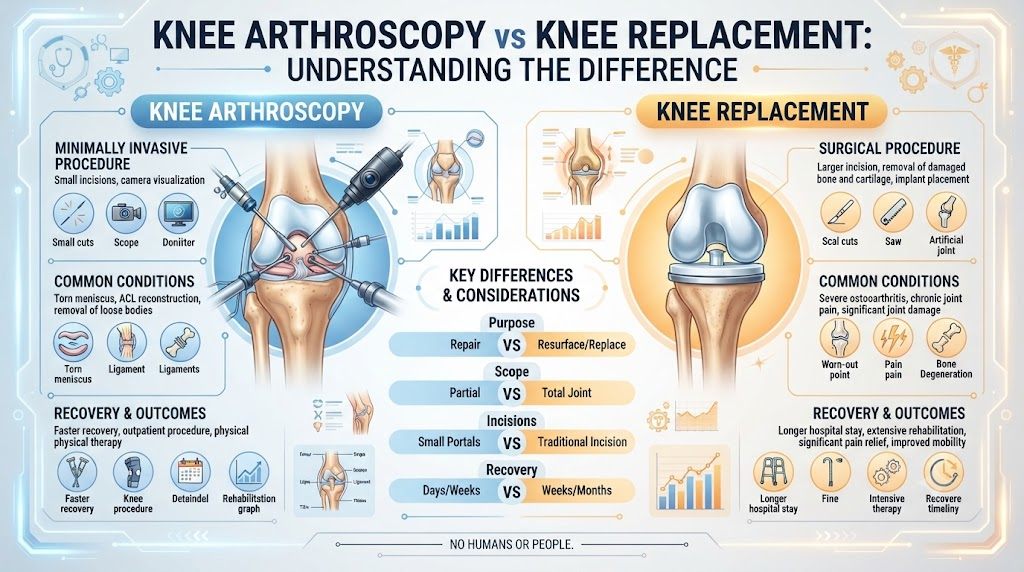
| Knee Arthroscopy | Mechanical catching, torn meniscus, loose bodies | Minimally invasive; outpatient (same-day discharge) | Several weeks, depending on the specific repair | Not recommended for widespread, bone-on-bone arthritis |
| Partial Knee Replacement | Severe arthritis isolated strictly to one joint compartment | Moderate surgical intervention; outpatient or 1 day inpatient | 4–8 weeks for basic daily functional activities | Requires intact ligaments; offers a faster recovery than total joint replacement |
| Total Knee Replacement | Severe, multi-compartment joint destruction | Major surgery; outpatient up to 2–3 days inpatient | 6–12 weeks for daily tasks; ongoing gains through 1 year | Highly effective for advanced wear; requires dedicated post-operative family support and rehabilitation |
A Family Decision-Making Framework
To evaluate joint replacement options methodically, families can follow this 10-step decision framework:
- Verify the Diagnosis: Ensure recent weight-bearing X-rays clearly explain the patient’s physical symptoms.
- Evaluate Daily Functional Limits: Determine whether joint pain prevents basic daily tasks, sleep, or social interactions.
- Review Conservative Steps: Confirm that appropriate trials of physical therapy, weight management, and injections have been evaluated.
- Schedule a Comprehensive Medical Clearance: Check blood pressure, cardiac health, blood sugar management, and dental health to minimize surgical risks.
- Establish Realistic Recovery Goals: Discuss desired post-operative activities, such as pain-free walking, gardening, or traveling.
- Compare Surgical Techniques: Ask whether the patient’s anatomy qualifies for a partial knee replacement or if a total replacement is safer and more durable.
- Review Risks Transparently: Discuss complications, including infection, blood clots, stiffness, nerve injury, and long-term implant loosening.
- Assess Hospital Quality Metrics: Evaluate the facility’s surgical volume, infection rates, emergency capabilities, and joint replacement certifications.
- Prepare the Home Environment: Remove tripping hazards, arrange a ground-floor sleeping space, and install safety handrails before the operation.
- Commit to the Rehabilitation Plan: Coordinate family schedules to support transportation, medication reminders, and home physical therapy exercises.
Common Mistakes Families and Patients Make
- Waiting for Extreme Physical Decline: Delaying surgery until severe joint deformity or extreme muscle loss occurs makes post-operative physical therapy harder and prolongs recovery.
- Assuming Recovery Happens Automatically: An implant restores the joint surfaces, but regaining strength, balance, and range of motion requires consistent participation in physical therapy.
- Relying Exclusively on Online Reviews: Internet ratings often reflect room decor or parking convenience rather than surgical quality, low infection rates, or low readmission numbers.
- Overlooking Home Safety Setup: Failing to install bathroom grab bars, secure loose rugs, or arrange appropriate seating ahead of time raises early fall risks.
- Comparing Progress to Friends or Relatives: Every patient heals at a unique pace. Comparing swelling, bending angles, or pain levels with others can cause unnecessary worry.
- Stopping Rehabilitation Too Early: Halting exercises as soon as acute surgical pain settles often leaves the patient with long-term muscle weakness or an uneven gait.
Essential Questions for Families to Ask the Specialist
Bring these practical questions to your loved one’s surgical consultation:
- How many total and partial knee replacements do you personally perform each year?
- Is my family member an appropriate candidate for partial knee replacement, or is total replacement the more durable choice?
- What specific alignment techniques, robotic tools, or implant systems do you recommend for their anatomy?
- What is this hospital’s surgical site infection rate for elective joint procedures?
- What multimodal pain management and nerve block protocols will be used to keep them comfortable after surgery?
- What specific blood clot prevention (anticoagulation) plan will be prescribed after discharge?
- How long will the hospital stay be, and what functional milestones must be achieved before discharge?
- When will physical therapy start, and how are outpatient sessions coordinated?
- Who should we contact if we notice persistent calf pain, fever, or wound drainage after returning home?
- What long-term physical restrictions should we keep in mind once the knee has healed?
Practical Caregiver Tips for Smooth Recovery
- Create a Centralized Medication Schedule: Maintain an updated written or digital chart to track pain medications, blood thinners, and routine prescriptions to prevent missed or doubled doses.
- Set Up a Comfortable Recovery Area: Position a sturdy, high chair with firm armrests in the main living space, ensuring supportive seating that allows for easy standing.
- Keep Walkways Clear and Well-Lit: Remove loose rugs, secure pet areas, tidy electrical cords, and install motion-sensor nightlights in hallways leading to the bathroom.
- Encourage Rest and Elevation: Remind your loved one to elevate their operated leg above heart level several times a day to manage swelling, using ice therapy as directed.
- Celebrate Gradual Progress: Acknowledge small daily improvements, such as walking a few more steps or gaining a few degrees of joint flexion, to keep motivation high.
Frequently Asked Questions
What are the main signs that indicate a loved one needs knee replacement surgery?
Key signs include severe joint pain that limits everyday activities like walking or standing, pain that disrupts sleep, persistent stiffness that makes bending difficult, visible leg misalignment, and joint space collapse on standing X-rays that fails to improve with non-surgical treatments like physical therapy or injections.
How long does a modern knee replacement implant typically last?
Contemporary knee implants are designed for durability. Clinical data indicates that many modern prostheses function well for 15 to 20 years or longer, depending on the patient’s activity level, body weight, overall health, and the precision of surgical alignment. Avoiding high-impact activities helps reduce wear on the components.
Is knee replacement surgery safe for elderly family members?
Yes, advanced age by itself does not rule out joint replacement. Orthopedic surgeons routinely perform successful knee replacements on patients in their 70s and 80s. The clinical focus centers on the patient’s general health, cardiac fitness, and functional goals rather than chronological age, supported by comprehensive pre-operative medical clearances.
What is the primary difference between total and partial knee replacement?
Total knee replacement replaces the damaged surfaces across all three compartments of the knee joint. Partial knee replacement treats only the worn compartment—typically the medial side—preserving the patient’s healthy bone, cartilage, and natural cruciate ligaments, which often provides a more natural-feeling joint and a faster recovery.
How severe is pain during recovery, and how can families help manage it?
While post-operative pain and swelling are normal, contemporary protocols utilize multimodal pain management, including regional nerve blocks, long-acting local anesthetics, and non-opioid medications. Families can assist by ensuring medications are taken on time, setting up ice therapy, and helping the patient elevate the leg above heart level.
When will my loved one be able to drive again after knee surgery?
Driving clearance depends on which leg was operated on, the patient’s recovery speed, and whether they have stopped taking prescription narcotics. Patients with left-knee surgery on automatic vehicles may resume driving within 2 to 4 weeks, whereas right-knee replacements typically require 4 to 6 weeks for brake reflex times to normalize.
What activities and sports are safe after knee replacement recovery?
Low-impact recreational pursuits are strongly encouraged once healing is complete. Swimming, stationary cycling, walking, golf, and gentle fitness exercises maintain joint health and cardiovascular fitness. High-impact sports like jogging, basketball, or contact sports are discouraged to prevent accelerated wear or implant loosening.
Why is hospital surgical volume important when selecting a facility?
Hospitals and surgical teams with high annual joint replacement volumes consistently demonstrate lower rates of surgical complications, deep infections, unplanned readmissions, and early implant revisions. High-volume centers use standardized clinical pathways and have nursing and physical therapy teams experienced in joint recovery.
How should we prepare our home before bringing a loved one back from surgery?
Prepare the home by clearing wide, level walking paths, removing loose throw rugs, placing non-skid bath mats and safety grab bars in the bathroom, setting up a firm chair with armrests, and arranging a ground-floor recovery area to minimize stair climbing during the first two weeks.
What potential surgical complications should families watch for at home?
Families should watch for signs of surgical site infection (such as worsening redness, warmth, or wound drainage), blood clots (indicated by calf swelling, heat, or localized tenderness), sudden chest pain or shortness of breath, persistent fever, and uncontrolled joint pain or stiffness. Report these signs to the surgical team promptly.
Conclusion
Guiding a loved one through knee replacement requires clinical clarity, balanced decision-making, and consistent family support. While the procedure offers a proven way to relieve chronic joint discomfort and restore mobility, a smooth recovery depends on comprehensive pre-operative evaluations, experienced surgical care, and steady participation in rehabilitation. By evaluating orthopedic centers based on surgical volume, transparent safety metrics, and structured recovery protocols, families can make confident, informed choices. Healthcare platforms like KneeHospitals.com provide helpful resources for comparing orthopedic facilities, understanding surgical options, and finding experienced specialists, ensuring your family feels informed and supported throughout the entire treatment journey.
Leave a Reply