DataOps Best Practices: How to Build Reliable and Scalable Data Pipelines

September 4, 2026 · 9 reads
Introduction
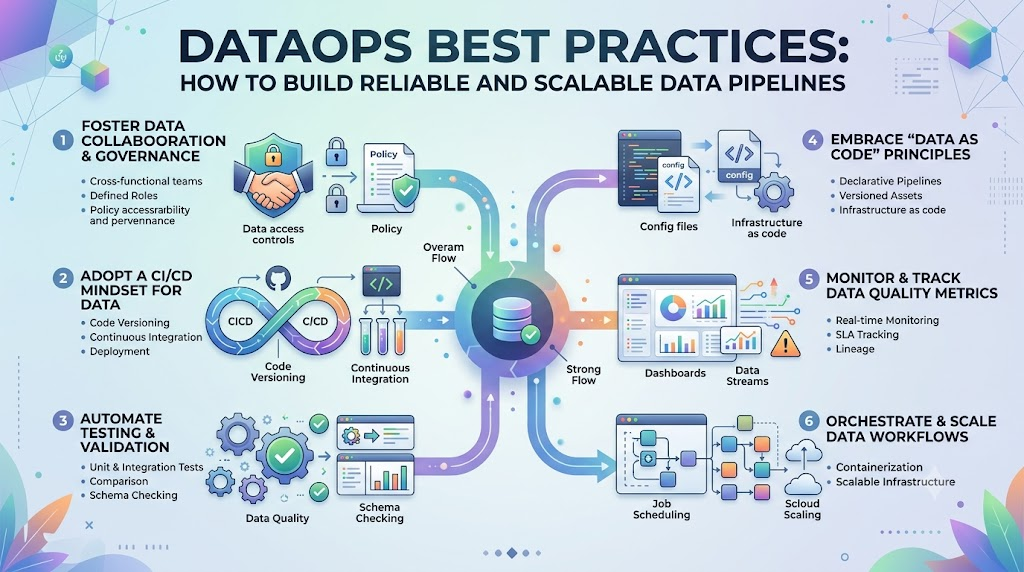
Data teams face a recurring challenge: data pipelines break silently, dashboards display stale figures, and engineers spend long hours troubleshooting obscure schema changes. These breakdowns erode stakeholder trust and slow down product development. While software engineering long ago adopted automated testing and continuous integration to stabilize code delivery, data platforms have historically lagged behind, relying instead on manual validation and reactive fixes. Applying established DataOps best practices changes this dynamic. DataOps brings rigor to the entire data lifecycle by combining agile principles, continuous integration and delivery (CI/CD), proactive data quality validation, and real-time observability. For data engineers, platform architects, and technology leaders, adopting these methods transforms fragile, unpredictable workflows into dependable systems. By exploring structured DataOps Training and foundational architectural patterns, teams can establish stable data products. This guide details practical patterns, operational trade-offs, and automation strategies necessary to design and operate resilient enterprise data platforms.
What Is DataOps and Why Does It Matter?
DataOps is an operational discipline and collaborative methodology focused on improving the quality, delivery speed, and operational reliability of data workflows. It unites data producers, data engineers, analytics professionals, and platform operators under a shared operational framework. Rather than treating data engineering as an ad-hoc scripting exercise, DataOps treats data as a production product requiring automated validation, predictable deployments, and continuous monitoring.
How DataOps Differs from Traditional DevOps
A common misconception is that DataOps is merely DevOps renamed for data teams. While both philosophies prioritize automation, continuous integration, and rapid feedback loops, data environments present distinct engineering challenges that standard software delivery models do not accommodate:
- Code State vs. Data State: In traditional software, source code and application binaries dictate behavior. If the code compiles and passes unit tests, it generally behaves predictably. In data pipelines, deterministic code often runs against non-deterministic external data. An orchestration task can execute without errors while generating corrupted outputs due to silent upstream data mutations.
- Schema Drift and Semantic Changes: Upstream applications frequently modify table structures, rename operational fields, or change data types without notifying downstream teams. Code-centric testing cannot detect these issues unless validation logic specifically inspects dataset boundaries.
- Irreversible Side Effects: Software deployments can easily be rolled back using traffic routing or container restarts. Rolling back a data error that has already mutated, overwritten, or contaminated downstream historical analytical storage is computationally expensive and complex.
Understanding these operational differences makes clear why general CI/CD tools alone cannot safeguard an organization’s analytical assets.
Core Pillars of a Resilient DataOps Architecture
A dependable data platform balances multiple interrelated functional layers. Each layer requires deliberate design choices to prevent operational bottlenecks.
Data Sources → Ingestion Layer → Storage / Lakehouse → Transformation → Quality Gates → Observability → Consumer Endpoints
1. Ingestion and Source Isolation
Ingestion handles the extraction of operational data across relational databases, SaaS platforms, event streams, and flat storage. A robust architecture separates raw, immutable landings from downstream operational models. This separation guarantees that raw inputs can be audited and reprocessed if transformation logic fails.
2. Scalable Storage and the Lakehouse Layer
Modern architectures rely on high-throughput object storage paired with transactional open-table formats such as Apache Iceberg, Delta Lake, or Apache Hudi, or managed cloud warehouses like Snowflake, BigQuery, and Amazon Redshift. These engines provide snapshot isolation, ACID transactions, and time-travel capabilities that make pipeline rollbacks technically feasible.
3. Declarative Transformation and Scheduling
Transformations convert raw, unprocessed data into normalized staging models and aggregated dimensional marts. Best-practice architectures favor declarative transformations where developers define desired end states through structured queries or declarative DAGs, while an underlying execution engine optimizes processing.
4. Continuous Quality Gates and Metadata Observability
Data checks must not run as afterthoughts once reporting layers are updated. Automated assertions must act as gates between platform layers, blocking bad records or pausing executions before contaminated tables propagate downstream.
Essential DataOps Best Practices
Implementing DataOps requires embedding defensive engineering principles directly into routine data engineering workflows.
Implement Comprehensive CI/CD for Data Pipelines
Treat data pipelines as mission-critical software. Every transformation script, pipeline DAG, schema definition, and infrastructure resource should reside in version control.
- Isolate Environments with Ephemeral Staging: Never test new transformations directly in production or against stale development environments. Use zero-copy cloning or automated seed scripts within pull request workflows to run tests against realistic data subsets.
- Automate Linting and Static Code Analysis: Enforce standard SQL and Python style guides automatically during code reviews. Static analysis identifies syntax errors, unindexed joins, or anti-patterns before code reaches an orchestrator.
- Decouple Deployments from Releases: Use parameter-driven feature flags and versioned data models (such as
dim_customers_v2) to allow engineers to deploy pipelines without immediately forcing consumers to switch downstream reporting.
Shift Data Quality Checks Left
Data quality testing must occur across every stage of processing rather than solely inside business intelligence dashboards.
| Test Type | Operational Purpose | Representative Tools / Techniques |
| Pre-Ingestion Contract Checks | Verifies source data adherence before loading | JSON Schema, Protocol Buffers, Data Contracts |
| Structural & Schema Tests | Catches column removals, unexpected nulls, and duplicate primary keys | dbt assertions, Great Expectations, Soda Core |
| Distribution & Statistical Tests | Detects statistical anomalies, value drift, and abnormal volume drops | Automated profiling assertions, Z-score validations |
| Downstream Integrity Tests | Validates reconciliation against upstream transactional ledgers | Cross-table row-count assertions, checksum hashes |
When validation fails, automated pipelines should route bad records into quarantine tables rather than terminating entirely, unless primary business keys are violated.
Orchestrate Workflows with Declarative Dependencies
Traditional cron-based task scheduling is fragile; jobs execute blindly based on clock time regardless of whether upstream dependencies have landed.
- Adopt Dynamic DAGs: Modern workflow engines like Apache Airflow, Dagster, and Prefect coordinate tasks based on upstream state, dynamic parameters, and explicit triggers.
- Implement Resilient Retries and Backoff Policies: External network timeouts and database locks are expected failure modes. Configure exponential backoff on ingestion tasks to prevent overwhelmed systems from crashing entirely.
- Enforce Idempotency Everywhere: An orchestrated task must produce the exact same outcome whether it runs once or five times across the same data partition. Replace blind inserts with declarative atomic operations, partition truncations, or upserts.
SQL
-- Example of an idempotent partition merge in modern SQL engines
MERGE INTO analytics.fact_orders AS target
USING staging.stg_orders AS source
ON target.order_id = source.order_id
AND target.order_date = source.order_date
WHEN MATCHED AND source.updated_at > target.updated_at THEN
  UPDATE SET
    target.order_status = source.order_status,
    target.order_amount = source.order_amount,
    target.updated_at = source.updated_at
WHEN NOT MATCHED THEN
  INSERT (order_id, customer_id, order_date, order_status, order_amount, updated_at)
  VALUES (source.order_id, source.customer_id, source.order_date, source.order_status, source.order_amount, source.updated_at);
Establish End-to-End Data Observability
Infrastructure uptime metrics do not guarantee operational data reliability. A compute cluster can register 100% availability while loading empty files due to silent upstream extraction bugs. Observability requires tracking five core dimensions:
- Freshness: Are source updates landing within defined Service Level Agreements (SLAs)?
- Volume: Did yesterday’s extraction return zero rows or ten times the typical historical volume?
- Schema: Have critical columns been dropped, added, or cast to incompatible types?
- Lineage: When a transformation fails, which downstream operational dashboards and ML features are affected?
- Distribution: Are continuous variables landing within expected numerical, categorical, or probabilistic boundaries?
By collecting metadata continuously across these dimensions, platform teams can detect and remediate pipeline drift before downstream business consumers notice reporting anomalies.
The Modern DataOps Tooling Ecosystem
No single tool provides complete DataOps coverage. A mature platform combines specialized tools via standard APIs and declarative configurations.
       [ Source Systems: OLTP Databases, Event Streams, APIs ]
                                  │
                                  ▼
[ Ingestion & Replication: Airbyte, Fivetran, Kafka / Managed Streaming ]
                                  │
                                  ▼
           [ Cloud Platform: Snowflake, Databricks, BigQuery ]
                                  │
      ┌───────────────────────────┴───────────────────────────┐
      ▼                                                       ▼
[ Transformations ]                                   [ Quality & Testing ]
   • dbt (Declarative SQL)                               • Great Expectations
   • Apache Spark / Engine SQL                           • Soda Core / dbt tests
      │                                                       │
      └───────────────────────────┬───────────────────────────┘
                                  │
                                  ▼
    [ Orchestration Engine: Apache Airflow, Dagster, Prefect ]
                                  │
                                  ▼
    [ Observability & Catalog: Monte Carlo, OpenLineage, Datahub ]
                                  │
                                  ▼
  [ CI/CD & Deployment Engine: GitHub Actions, GitLab CI, Terraform ]
Transformation and Modeling Tools
Transformations benefit heavily from declarative patterns. Frameworks like dbt allow software engineering practices—such as modularity, documentation-as-code, and embedded testing—to be written directly in SQL or Python. This abstraction eliminates handwritten DDL statements and automatically documents dependency graphs.
Orchestration Engines
Orchestrators such as Apache Airflow, Dagster, and Prefect coordinate execution across decoupled components. Dagster approaches workflows from an asset-based paradigm, tracking the state of tables rather than purely sequential tasks. Airflow provides extensive ecosystem connectivity, while Prefect offers dynamic Python-first execution.
Infrastructure as Code (IaC)
Manual infrastructure provisioning inside cloud provider consoles creates non-reproducible environments and configuration drift. Using Terraform, teams can declare warehouses, storage buckets, IAM permissions, service accounts, and ingestion endpoints inside version-controlled configuration files, guaranteeing parity across staging and production.
Common Implementation Challenges and Anti-Patterns
Transitioning to a DataOps model introduces technical and organizational hurdles that require proactive management.
Anti-Pattern 1: Treating DataOps Solely as a Tooling Upgrade
Purchasing modern orchestration or observability software does not resolve fundamental engineering deficiencies. If pipeline logic is tightly coupled, non-idempotent, and untested, running it inside a new orchestrator simply executes brittle code more visibly. Teams must prioritize testing patterns and modular design over tooling volume.
Anti-Pattern 2: The Monolithic Transformation Pipeline
Building single transformation scripts containing thousands of lines of nested subqueries makes root-cause debugging nearly impossible. A change to one metric can silently break completely unrelated calculations. Instead, divide monolithic workflows into isolated, functional layers: staging, intermediate business entities, and dimensional presentation models.
Anti-Pattern 3: Alert Exhaustion and Lack of Incident Ownership
Configuring dozens of non-critical pipeline alerts causes alert fatigue. When hundreds of low-priority Slack notifications fire daily, on-call engineers inevitably ignore genuine platform failures. Define explicit Service Level Objectives (SLOs) and configure high-severity alerts only for actionable anomalies affecting downstream consumer contracts.
Enterprise Implementation Roadmap
Transitioning an existing analytics footprint toward an automated DataOps model should proceed incrementally:
Audit & Version Control ──► Automated Smoke Testing ──► CI/CD Staging Workflows ──► Observability & Monitoring
- Audit and Consolidate Source Control: Ensure that every transformation script, dashboard definition, and orchestration configuration is tracked within Git repositories with branch protection rules.
- Implement Minimal Smoke Testing: Introduce non-null and uniqueness assertions onto business-critical tables. Establish alerts that trigger when primary keys are violated.
- Build an Automated CI/CD Pipeline: Configure automation servers (such as GitHub Actions or GitLab CI) to test newly committed code against temporary dev databases or sandboxes before merging to main branches.
- Deploy Metadata-Driven Observability: Monitor freshness metrics and data volume baselines automatically at ingestion boundaries to eliminate silent failures.
Career Paths: Engineering, Architecture, and Professional Services
The demand for professionals who understand both distributed systems and data engineering operations continues to expand.
                               ┌──────────────────────────────┐
                               │   Certified DataOps Architect │
                               │  - Enterprise Platform Design │
                               │  - Security, Cost & Governance│
                               │  - Multi-engine Architecture  │
                               └──────────────▲───────────────┘
                                              │
                                              │ Advanced Progression
                                              │
┌──────────────────────────────┐              │
│      Data Engineer /         │              │
│      DevOps Specialist       ├──────────────┴───────────────┐
│  - Pipeline Development      │                              │
│  - Basic SQL/Python Workflow │                              │
└──────────────┬───────────────┘                              │
               │                                              │
               │ Upskilling via Structured Training           │
               ▼                                              ▼
┌──────────────────────────────┐               ┌──────────────────────────────┐
│  Certified DataOps Engineer  │               │   DataOps Consulting Role    │
│  - Pipeline CI/CD Automation │               │  - Platform Modernization    │
│  - Quality Assertions (dbt)  │               │  - Framework Standardization │
│  - Orchestration & Recovery  │               │  - Incident Mitigation       │
└──────────────────────────────┘               └──────────────────────────────┘
A Certified DataOps Engineer focuses on the mechanical implementation of automated pipelines, writing comprehensive test suites, configuring CI/CD deployment routines, and setting up lineage tracking. They spend their time optimizing DAG runs, ensuring idempotent SQL executions, and reducing time-to-recovery when upstream formats change.
A Certified DataOps Architect evaluates systemic trade-offs across enterprise platforms. They determine how lakehouse architectures, cross-region storage, data governance mandates, and cost budgets intersect. Architects establish platform patterns, security boundaries, and enterprise toolchains to ensure individual teams can deploy workflows independently without introducing structural debt.
For organizations dealing with legacy warehouse complexity or fragmented operations, external DataOps consulting and specialized professional services provide the technical patterns necessary to standardize platforms without halting existing business operations.
Practical Tips / Key Takeaways
- Every Transformation in Git: Never apply changes directly inside cloud warehouses or production orchestration dashboards without an audited pull request.
- Make Every Pipeline Step Idempotent: Design transformation steps so that re-running them over historical data overwrites existing partitions predictably rather than duplicating records.
- Quarantine Corrupted Data Automatically: Isolate invalid records into dedicated dead-letter tables to preserve downstream pipeline continuity while engineering teams triage issues.
- Alert on Business Impact: Focus notifications on Service Level Indicators that matter to downstream business consumers, such as dataset delivery delays or dropped primary keys.
- Automate Sandbox Environments: Use modern database cloning and dynamic schema creation within CI pipelines to validate SQL changes against production-like data topologies before merging.
FAQs
What is DataOps?
DataOps is an automated, collaborative approach to data engineering that applies agile development, continuous integration, proactive testing, and deep observability to data pipelines. It aims to reduce cycle times for delivering analytical models while ensuring high data quality and operational platform reliability.
How is DataOps different from DevOps?
DevOps focuses on software code stability, deployment frequency, and server infrastructure availability. DataOps expands on these software engineering practices to address non-deterministic data states, unpredictable schema drift, external data corruption, and the unique dependencies of analytical processing engines.
What are the core DataOps best practices?
Key practices include managing all transformations and orchestrations in version control, implementing CI/CD with isolated testing sandboxes, shifting data quality assertions upstream, designing strictly idempotent pipeline steps, and tracking continuous observability metrics across data freshness, volume, and lineage.
Why is data pipeline idempotency essential?
An idempotent pipeline step guarantees that running the task multiple times across the same input dataset produces the exact same end state. This design prevents duplicate rows, eliminates partial-write corruption during network disconnects, and simplifies incident remediation.
What tools are commonly used in a DataOps workflow?
Common tools include git-based version control systems, workflow orchestrators like Apache Airflow, Dagster, and Prefect, declarative transformation frameworks like dbt, data validation packages such as Great Expectations and Soda, and cloud infrastructure automation tools like Terraform.
How does DataOps improve data quality?
DataOps replaces manual spot-checking with automated validation gates directly within the ingestion and transformation lifecycle. By verifying schema compliance, column nullability, and statistical distribution boundaries before publishing data downstream, teams identify and quarantine corrupted records early.
What role does a Certified DataOps Engineer play?
A Certified DataOps Engineer designs, automates, and maintains delivery pipelines. They configure automated integration tests, manage workflow orchestration DAGs, monitor platform observability signals, resolve schema evolution errors, and implement CI/CD deployment automation across diverse environment stages.
What skills are needed to pass a DataOps certification exam?
Professionals preparing for certification need a strong foundation in modern data engineering, proficiency in SQL and Python, deep familiarity with workflow orchestrators, understanding of declarative testing frameworks, experience with cloud platforms, and expertise in version control automation.
What does DataOps consulting typically involve?
DataOps consulting services assist organizations in modernizing fragile analytics architectures. Consultants review existing data platforms, eliminate manual deployment bottlenecks, implement automated CI/CD and data quality frameworks, streamline orchestration dependencies, and train internal data teams on operational best practices.
When should an organization adopt DataOps practices?
Organizations should adopt DataOps when expanding data platforms beyond simple point-to-point scripts, when analytical outages begin impacting business operations, or when data engineers spend more operational hours triaging pipeline failures and answering stakeholder complaints than developing new platform features.
Conclusion
Adopting proven DataOps best practices is essential for transforming fragile, manual data pipelines into resilient, enterprise-grade analytical platforms. By embedding continuous integration, automated quality assertions, dynamic orchestration, and deep observability into routine engineering lifecycles, teams eliminate silent data corruption and deliver reliable data products to business decision-makers. Developing these operational capabilities requires structured knowledge across modern tools and architectural patterns. Through hands-on learning, practical implementations, and technical resources available at DataOpsSchool.com, engineers and platform architects can build the skills necessary to master modern data platform operations and build reliable data workflows.
Leave a Reply