Complete Amaravati Travel Guide: Historic Places to Visit, Timings & Local Tips

September 4, 2026 · 7 reads
Introduction
Solo travel offers a rare chance to strip away distractions and let a landscape speak for itself. You set your own pace, pause where you choose, and linger until an ancient detail reveals its story. Amaravati, situated along the curve of the Krishna River in Andhra Pradesh, is built for this brand of mindful, independent exploration. Far from the rush of packed tour buses and hurried selfie lines, this historic riverside settlement offers solitary travelers vast open ruins, meditative riverbanks, and quiet village lanes where classical art meets daily rural life. Wandering on your own allows you to study intricate stone friezes at your leisure, sit quietly beneath towering sacred figures, and observe evening riverside rituals without watching the clock. If you are seeking an unhurried, contemplative escape, discovering the tranquil places to visit in Amaravati provides a grounding travel experience.
Why Amaravati Appeals to the Independent Wanderer
Solo travelers usually look for three things in a destination: safe and straightforward navigation, cultural depth that rewards patience, and quiet spaces to sit, sketch, read, or think. Amaravati provides all three effortlessly.
Because the town is compact, you do not need complex transport arrangements or expensive guided tours to explore it thoroughly. You can walk between most major archaeological and cultural sites, catch an auto-rickshaw across the village fields, and find plenty of solitary benches with sweeping river views. In this ancient river valley, solitude feels natural, giving you room to appreciate two thousand years of South Indian art and philosophical thought.
Solitary Reflections: Key Places to Visit in Amaravati
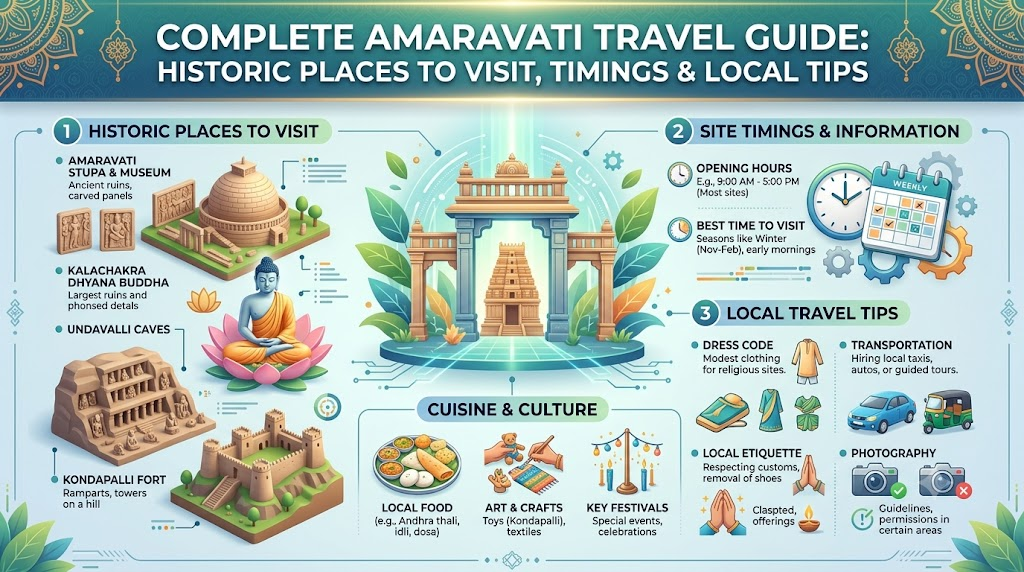
To design a self-guided journey focused on tranquility, focus on these monuments, river terraces, and cultural collections.
1. The Amaravati Mahachaitya (Great Stupa)
Arrive at the Great Stupa grounds right as the gates open in the morning. When the morning dew still clings to the grass, you will often find yourself completely alone along the ancient circumambulatory path.
The site does not overwhelm you with noisy commercial stalls. Instead, you walk beside the circular brick foundation of a monument that once drew monks and pilgrims from across ancient Asia. Without a tour group pushing ahead, you can inspect the carved Ayaka platforms up close, run your fingers along the cool limestone railing posts, and sit under the shade of a neem tree with your field journal.
2. The ASI Archaeological Museum
Visiting an art museum solo is always superior to visiting in a group because you control the cadence. The Archaeological Survey of India museum in Amaravati contains salvaged relief panels carved in luminous white limestone during the Satavahana era.
Take your time examining the intricate narrative friezes. Notice how sculptors rendered human emotion, courtly pageantry, and animal motifs with fluid realism. Stand before the iconic Purnakumbha reliefs or trace the fine facial lines on Buddha figures without feeling pressured to move along. The quiet, cool exhibition halls offer a focused space to study classical craftsmanship.
3. The 125-Foot Dhyana Buddha Statue
Set high on a river bluff, the massive Dhyana Buddha statue looks directly out over the flowing currents of the Krishna River. While striking from a distance, the site is designed with personal contemplation in mind.
Head inside the base of the statue, where cool stone floors lead to quiet interior galleries and alcoves dedicated to meditation. Afterwards, step outside onto the terraced gardens. Find a quiet corner along the outer perimeter wall facing the river. As the breeze sweeps off the water, it makes an ideal spot to read, sketch, or practice silent meditation as the afternoon light softens.
4. Amareswara Swamy Temple
Stepping alone into an ancient, living temple allows you to absorb subtle sensory details that group travel often drowns out. At the Amareswara Swamy Temple, the scent of burning camphor, the cool stone under your bare feet, and the distant chant of priests create an immersive atmosphere.
Take time to walk through the outer pillared mandapams away from the main prayer queues. These stone pillars carry medieval epigraphs etched in classical Telugu and Sanskrit scripts. Observing the quiet devotion of local villagers who come to lay fresh flowers before the towering marble Shiva Lingam provides an unmediated window into local spiritual life.
5. Dharanikota Ramparts
For a solo traveler who enjoys off-the-beaten-path walking, the rural trails around Dharanikota offer an unstructured adventure. This quiet farming hamlet was once a heavily fortified inland river port that sent ships toward the Bay of Bengal.
Walking along the raised earthen embankments and quiet irrigation canals, you will see farmers tending green chili and paddy fields right atop ancient city walls. The sense of layered history beneath an ordinary farming day is palpable, and local villagers along the path are quick to offer a warm nod or direction if you stop to say hello.
6. The Krishna River Ghats at Dusk
End your day on the wide stone steps of the Krishna River ghats. In the late afternoon, the intense sun gives way to a gentle breeze, and the river turns a deep amber.
Sitting on the steps by yourself, you can watch wooden skiffs carry farm produce across the water while devotees float tiny oil lamps onto the gentle current. The sound of river water lapping against the stone steps paired with the faint chime of evening temple bells creates a deeply soothing farewell to the day.
Solo Activities That Deepen the Journey
- Photography and Sketching: The limestone carvings at the museum and the interplay of light and shadow across the stupa foundation provide endless visual inspiration for artists and photographers who prefer working without interruption.
- Solo Dining in Local Messes: Dine like a local by stepping into a traditional mess near the bus stand. Order an authentic vegetarian thali on a banana leaf—it is quick, fresh, budget-friendly, and offers an authentic taste of coastal Andhra hospitality.
- Riverbank Journaling: Bring a pocket notebook to the Dhyana Buddha garden benches in the late afternoon to write, plan, or simply enjoy an uninterrupted view across the river plain.
A Mindful One-Day Itinerary for Solo Travelers
This route is designed to maximize solitude and keep foot travel relaxed.
- 07:30 AM – 09:00 AM: Solitary Walk at the Stupa. Start early at the Amaravati Mahachaitya before any weekend visitors arrive. Enjoy an unhurried, quiet circuit around the stone perimeter.
- 09:30 AM – 11:30 AM: Deep Dive at the ASI Museum. Spend two undisturbed hours examining the stone friezes and historical exhibits in the air-cooled galleries.
- 12:00 PM – 01:30 PM: Simple Lunch & Rest. Enjoy a traditional lunch of spicy rasam, fresh curds, and hot rice at a village mess, followed by sweet filter coffee.
- 02:00 PM – 03:30 PM: Quiet Wandering in Dharanikota. Take an afternoon stroll along the earthen dykes and village lanes of ancient Dharanikota.
- 04:00 PM – 05:00 PM: Inscriptions at Amareswara Temple. Visit the temple courtyard to study the historic stone pillars and watch the early evening abhishekams.
- 05:30 PM – 06:45 PM: Sunset Meditation at Dhyana Buddha. Walk up to the terraced gardens to meditate in the lower hall and watch the sun dip below the Krishna River.
Solitary Traveler’s Site Evaluation
| Spot | Quiet Factor | Solo Suitability | Recommended Focus | Best Hours |
| Amaravati Stupa | Very High | Excellent | History study, quiet walking | 07:30 AM – 09:00 AM |
| ASI Museum | High | Excellent | Art appreciation, sketching | 10:00 AM – 12:00 PM |
| Dhyana Buddha | High | Excellent | Meditation, reading, sunset | 05:00 PM – 06:30 PM |
| Amareswara Temple | Moderate | Very Good | Cultural immersion, epigraphy | 03:30 PM – 04:30 PM |
| Krishna River Steps | Moderate | Good | People-watching, reflection | 06:00 PM – 07:00 PM |
Practical Solo Logistics
Safe and Simple Transportation
Reaching the town on your own is straightforward. From Vijayawada Junction or Guntur Junction, government-operated APSRTC buses depart regularly from the main bus stations directly to Amaravati. The journey takes just over an hour. Once in town, you can easily walk between sites, or hire an auto-rickshaw for quick hops to Dharanikota or the Dhyana Buddha complex.
Best Months to Wander
Visit between November and February. The weather is dry and pleasant, allowing you to walk five or six kilometers across the town throughout the day without heat fatigue. Coastal Andhra summers from March to June can be punishing for solo walkers, with temperatures frequently passing 40°C.
Practical Tips
- Carry a Small Daypack: Keep your hands free while walking. Pack a stainless steel water bottle, a small journal, sunglasses, and a lightweight cotton scarf to cover your head or shoulders when entering sacred sites.
- Keep Small Change Handy: Solo travel means frequent small expenses—bus tickets, shoe storage counters at temples, and tender coconuts. Keep plenty of small banknotes and coins ready.
- Respect Local Etiquette: Amaravati is a quiet, traditional settlement. Dress modestly with shirts covering your shoulders and trousers covering your knees to feel comfortable and welcomed everywhere you go.
- Check the Museum Calendar: The ASI Museum is closed on Fridays. Make sure your solo travel days fall on a Saturday through Thursday so you don’t miss out.
FAQs
Q1: Is Amaravati safe for solo travelers, including solo female travelers?
Yes, Amaravati is a safe, welcoming, and traditional pilgrim town. Local shopkeepers and residents are polite and helpful. Standard solo travel precautions apply: dress modestly, avoid isolated riverbanks late at night, and keep your phone charged.
Q2: Can I explore all the major places to visit in Amaravati without hiring a car?
Yes. The town is pedestrian-friendly, with the Stupa, Archaeological Museum, and Amareswara Temple located within a brief walk of one another. Auto-rickshaws are abundant for easy trips to the Dhyana Buddha complex or neighboring Dharanikota.
Q3: Where should a solo traveler stay when visiting Amaravati?
While the town has basic dharamshalas and local lodges, solo travelers wanting a wider variety of clean hotels, reliable Wi-Fi, and transport hubs usually base themselves in Vijayawada or Guntur and make Amaravati an easy day trip.
Q4: How much money does a solo day trip to Amaravati typically cost?
It is an affordable trip. Local bus transit from Vijayawada or Guntur, modest entry tickets, auto-rickshaw fares, and traditional meals typically total between 500 to 1,200 Indian rupees for an entire day.
Q5: Is there a quiet space dedicated to silent meditation?
Yes, the indoor gallery and halls at the base of the 125-foot Dhyana Buddha statue offer a cool, quiet setting suitable for silent contemplation and meditation away from street noise.
Q6: Can I use UPI payments as an independent traveler in town?
UPI digital payments are accepted at most local tea shops, bakeries, and small stores. However, having 200 to 300 rupees in physical cash is essential for shoe counters, small temple offerings, and state transport buses.
Q7: What is the best way to get to Amaravati from the nearest train station?
Take a short auto-rickshaw ride from Vijayawada Railway Station to the Pandit Nehru Bus Station (PNBS), where direct APSRTC express and local buses depart regularly for Amaravati bus station.
Q8: Are guided tours necessary to understand the monuments?
No, self-guided exploration works well. The Archaeological Survey of India has installed informational plaques explaining the history of the Stupa and excavated relics, while the museum displays offer clear bilingual context in English and Telugu.
Q9: Can a solo traveler take a boat ride on the Krishna River?
Local boatmen offer shared seats or private trips along the river ghats. If traveling alone, verify that life jackets are provided on board and agree upon the fare before departing the steps.
Q10: What nearby spot can a solo traveler easily add to this itinerary?
The multi-tiered, rock-cut Undavalli Caves, located roughly midway between Amaravati and Vijayawada, make an easy and fascinating solo stop along the return bus route.
Conclusion
Traveling solo through Amaravati allows you to connect with centuries of history on your own terms. Rather than rushing through highlights, you have the freedom to stand quietly beneath ancient limestone carvings, sit in peaceful contemplation within the base of the Dhyana Buddha statue, and watch the day wind down along the calm steps of the Krishna River. Free from external schedules and commercial tourist crowds, the diverse places to visit in Amaravati provide an enriching, restorative journey through the historic heart of Andhra Pradesh.
Leave a Reply