Beginner-Friendly Guide to Mastering Linux and Core Infrastructure Basics

September 30, 2026 · 20 reads
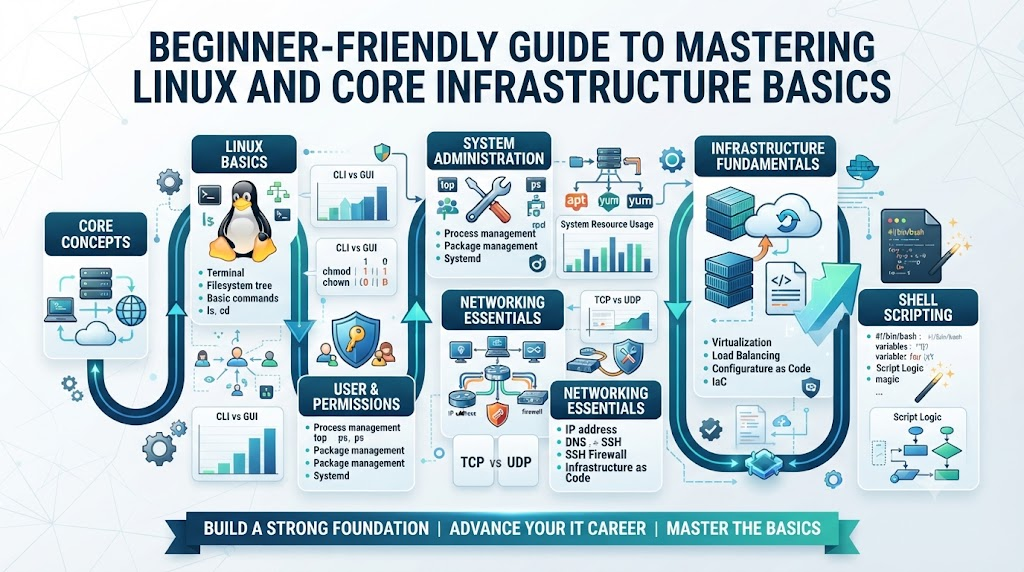
Stepping into the world of cloud infrastructure can feel overwhelming. Many aspirants open their laptops and freeze because hundreds of new platforms appear on their screens. You might watch random video tutorials for weeks without feeling any closer to a real job. Learners need clear, organized directions instead of chaotic video playlists. Without an organized plan, you waste months studying random topics. You need to know exactly which skill to master first and what to practice next. Having a structured timeline saves you immense time and effort. Fortunately, a supportive open community exists online to help you succeed. It is called DevOpsSchool org. This platform serves as a friendly career guide for everyone. It provides clear directions from your very first day. You never have to guess your next move again. Let us explore a fresh perspective on how you can build a stable tech career today.
Discovering Your Open Learning Community
Many students want to know what DevOpsSchool.org provides. It is an open online hub built specifically for technology learners. The platform offers free 90-day guides to structure your daily practice. You also receive access to a comprehensive open tool directory. This directory helps you find the right software utilities instantly. Furthermore, the platform features an exam registry that lists all important industry tests. It also offers professional career assistance to help you land interviews. Studying without a solid strategy is a major mistake. It only drains your energy and wastes months of valuable time. You need a reliable DevOps roadmap to guide your daily efforts. A roadmap shows you what topics to cover step by step. First, you master basic systems. Then, you transition into automation workflows. This clean order makes complex subjects much easier to digest. You should follow a structured DevOps learning path to stay fully focused. A good learning path keeps your stress levels low and your motivation high.
Essential Core Skills for New Engineers
You must build a strong foundation before touching advanced software. First, you need to learn Linux inside and out. Linux is the core operating system powering almost every internet server. Next, you must learn version control systems. Version control allows you to save, track, and share your code safely. Also, you need to learn basic scripting. Scripting means writing short commands to automate repetitive chores. These fundamental abilities form a sturdy DevOps engineer roadmap for your professional journey. You will rely on these exact skills during your daily job duties. Therefore, you must practice them repeatedly. Modern engineers use specialized utilities to speed up application delivery. These vital programs are called DevOps tools. You need to select the most effective ones for your home labs. Some software helps you write code, while other programs test it automatically. Core automation utilities make your daily tasks much faster. Automation means letting the computer handle the boring routine work. Always start with simple utilities and master them completely before moving forward.
Evaluating Technology Options Side by Side
You will encounter many software applications that solve similar problems. Therefore, you must learn to compare them carefully. A detailed DevOps tools comparison helps you choose the right program wisely. You need to compare popular container platforms. Containers are lightweight, secure boxes that package your web apps. Next, you must compare code automation pipelines. Pipelines are the smooth paths your software travels to reach live servers. Finally, you must compare monitoring systems. Monitoring means watching your digital applications to ensure they never crash unexpectedly. Practicing these concepts hands-on is the best strategy. Here is a helpful comparison table to guide your beginner practice sessions.
| Skill Area | Key Focus | Beginner Project | Why It Matters |
| Linux | Terminal Commands | Write a file script | Powers most web servers |
| Version Control | Saving Code | Push files to GitHub | Tracks your daily work |
| Containers | Packaging Apps | Build a web app box | Makes code run anywhere |
| Code Pipelines | Easy Automation | Build a test runner | Saves time on testing |
Exploring System Reliability and Platforms
Web applications must stay online around the clock for global users. They cannot afford to crash even for a single minute. Site reliability specialists prevent these expensive outages. These dedicated experts keep large web apps running without downtime. Downtime means the website is broken and offline for customers. You will need a reliable SRE roadmap to master this specific job role. You will learn how to monitor server health very closely. You will also learn how to troubleshoot sudden errors very fast. Some engineers focus on helping other developers work much faster. They build self-service internal systems for their development teams. These are called internal developer platforms. Platform engineers build these wonderful systems from scratch. If this career sounds exciting, follow a dedicated Platform Engineering roadmap. You will learn how to make deployment utilities simple for your entire team. You act as a helpful technical bridge across departments.
Validating Skills with Industry Exams
You need to show prospective employers what you are capable of achieving. Taking official industry exams is an exceptional way to prove your knowledge. These tests show that you understand essential cloud computing concepts. Earning DevOps certifications helps your resume stand out from the competition. Hiring managers actively look for these official credentials during recruitment. Certificates also give you a concrete, measurable goal to aim for. Studying for an official test forces you to read documentation deeply. You should never try to pass the hardest exam on day one. You must start with simple foundational tests. Foundational tests cover basic cloud terminology and rules. After that, you can tackle advanced practitioner exams. A clear DevOps certification roadmap will direct your study order. It tells you which beginner test to take first and which advanced exam to schedule later.
Examining Career Paths and Goals
Here is another markdown table comparing study tracks and career goals.
| Target Role | Best Starting Track | Helpful First Exam | Top Goal |
| Cloud Specialist | Cloud Basics | Cloud Intro Test | Learn cloud servers fast |
| Pipeline Expert | Pipeline Basics | CI/CD Flow Exam | Master code delivery |
| Uptime Guardian | System Health | Linux Admin Test | Keep websites online |
| Platform Maker | Developer Tools | Kubernetes Exam | Build internal portals |
Landing an employment offer is your ultimate destination in this journey. You need to build a clean code portfolio. Share your projects online so hiring managers can review your code. There are thousands of exciting DevOps jobs waiting for qualified individuals. Companies desperately need tech workers who understand automation workflows. Many everyday professionals have made this career transition successfully. Here are some real-life success stories from motivated learners:
- A system administrator learned cloud automation and secured a promotion.
- A recent college graduate built three portfolio projects to get hired.
- A software developer learned deployment pipelines to speed up their team.
- A retail worker studied basic Linux at night and landed a support role.
Common Mistakes to Avoid When Learning
Studying technical skills can sometimes feel tricky and confusing. Avoid these eight common mistakes while you explore cloud engineering:
- Memorizing terminal commands without doing hands-on practice labs.
- Collecting official certificates without building real working projects.
- Trying to learn every single software tool at the exact same time.
- Ignoring basic Linux commands and file management skills.
- Skipping computer networking basics because they seem too intimidating.
- Failing to ask the online community for help when you feel stuck.
- Copying internet code blindly without understanding how it functions.
- Giving up too early when your code throws an unexpected error.
You never have to learn all by yourself in isolation. DevOpsSchool.org is ready to support your professional growth. It offers completely open roadmaps for you to follow. The community contributions are massive and incredibly helpful. You can also use free career directories to find hiring companies. The community maintains a supportive and welcoming tone always. Follow this simple 7-step career launch plan to succeed:
- Goal: Pick your target tech role.
- Search: Look up required basic skills.
- Shortlist: Pick a few simple tools.
- Compare: Evaluate platforms side by side.
- Ask: Get wise community advice.
- Verify: Build home labs to test skills.
- Decide: Choose your path and apply.
Frequently Asked Questions
Question 1: Do I need a college degree to get a tech job?
No, you do not need a college degree. Many companies care much more about your practical skills. They want to see what you can build. If you have a good project portfolio, you can get hired. Just focus on learning and making real projects at home. This proves you can do the work well.
Question 2: How long does it take to learn these skills?
It depends on how much free time you have. Most people take six to nine months to study. You must practice a few hours every single week. Consistency is the magic key to true success. If you study every day, you will learn much faster. Just do not rush through the basics.
Question 3: Should I learn coding before anything else?
You only need basic coding skills at the start. Python or bash scripting is usually more than enough. You do not need to be a master programmer. You just need to write short, simple scripts. These scripts will help automate your daily tasks. You can learn more advanced coding later if you want.
Question 4: What is the very first thing I should learn?
You must learn Linux first. Linux is the foundation of almost everything in cloud tech. If you know Linux, other tools will make sense quickly. Spend a lot of time practicing Linux commands. Practice moving files and reading system logs. This will make your future learning much smoother.
Question 5: Do certifications guarantee a job offer?
No, certifications do not guarantee a job offer. They only help you secure an interview. Employers still want to see your practical skills. You must pass a technical test during the interview. So, you must pair your certificates with real projects. Both elements together make you a strong candidate.
Question 6: How do I build a portfolio with zero experience?
You can build a portfolio by doing personal home projects. Make a web server on your laptop. Write a script to back up your personal files. Put all this code on GitHub. Write a clear summary for each project. Hiring managers will look at this and see your dedication.
Question 7: Are these tech jobs very stressful?
Tech jobs can get busy from time to time. But, a good team helps manage the stress easily. When systems break down, you must fix them fast. This is why automation is so important. Automation does the boring work for you. It keeps your daily stress levels much lower.
Question 8: Is it too late for me to switch careers?
It is never too late to switch careers. Many people start tech in their thirties or forties. Your past work experience is actually very valuable. You already know how to solve problems and talk to people. Just add technical skills to your great background.
Question 9: What if I get stuck while learning a hard tool?
Everyone gets stuck sometimes, and it is very normal. When this happens, just take a short break. Then, ask for help in an open community. Explain what you tried to do. Friendly engineers will gladly help you fix the error. Never suffer alone in silence.
Question 10: Can I use Windows to learn these skills?
Yes, you can use Windows for your studies. But, you should install a Linux virtual machine. A virtual machine is a fake computer inside your real computer. This lets you practice Linux commands safely. Later, you can rent a cheap cloud server for testing.
Question 11: Do I need to buy expensive software?
No, you do not need expensive software. Almost all the tools you need are totally free. They are open source tools. This means anyone can use them without paying money. You only need a basic computer and internet access. Learning tech is very cheap to start.
Question 12: How do I prepare for my first job interview?
You should practice talking about your projects out loud. Be ready to explain how you fixed past errors. Review your basic Linux and network concepts. Do not lie if you do not know an answer. Just say you would search for the solution. Honesty is always best.
Conclusion
Starting a new tech career is an amazing adventure. You must always stay consistent with your daily studies. Make sure to build real practice labs on your computer. Follow a structured schedule every week to stay on track. Never stop learning with your supportive community. The tech world changes fast, but a good plan keeps you safe. Keep practicing your skills daily and do not give up. Ask questions when you need help and be proud of every win. Finally, remember to use DevOpsSchool.org to guide your daily steps. It will help you reach your goals much faster. Good luck on your tech journey!
Leave a Reply